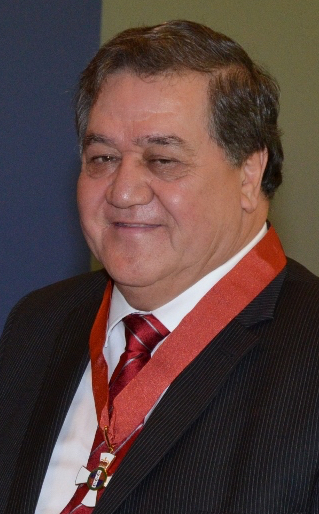
Graham Smith
Professor Graham Hingangaroa Smith · Kaupapa Māori Theory · Transformative Praxis
The scholar who gave communities their language for what they were already doing. When Kōhanga Reo parents pulled their children out of the mainstream and built language nests from scratch in the early 1980s, they weren’t following anyone’s theory. Smith arrived after, named what he saw, and that naming gave it institutional power.
Photo: New Zealand Government, Office of the Governor-General · CC BY 4.0
🧑🏫 Biography & The Theory’s Origin
Graham Hingangaroa Smith grew up in an Aotearoa where the Native Schools system had done its work. Not spectacularly, but steadily: generations of Māori children passing through institutions that defined their culture as a deficit, their language as an obstacle, and their communities’ knowledge as irrelevant to what counted as education. By the time Smith came to his work, the evidence was in. The mainstream had had over a century to produce Māori flourishing. It had not.
What changed things was not a policy. It was a movement. In 1982, Māori parents and grandparents, many of them the last fluent speakers their families had, began building Kōhanga Reo — language nests — with their own hands, in their own communities, on their own terms. They were not following a curriculum theorist’s plan. They were answering a single question: if the state won’t save our language, what will we do? The answer was: we will build something ourselves. Smith observed this, worked alongside it, and wrote what became Kaupapa Māori Theory — not as a blueprint for communities to follow, but as a description of what communities had already understood.
His 1997 PhD thesis at the University of Auckland, The Development of Kaupapa Māori: Theory and Praxis, remains the foundational text. It drew explicitly on Antonio Gramsci (organic intellectuals, hegemony) and Paulo Freire (conscientisation, critical praxis), but pushed both further: the goal was not merely raising consciousness but building alternative institutions. Kura Kaupapa Māori — Māori-medium schools operating on explicitly Māori educational and cultural principles — were the proof-of-concept. Smith was among those who co-founded the movement.
He held professorships at the University of Waikato, the University of Auckland, the University of York in Canada, and Massey University. Working closely with Professor Linda Tuhiwai Smith, he helped build Kaupapa Māori as a research tradition as well as an educational philosophy — one that insisted Māori communities own, conduct, interpret, and benefit from research about Māori. The academy adopted the framework; Smith continued asking whether it was doing so honestly.
🧭 The Six Principles of Kaupapa Māori
Smith articulated six principles that distinguish Kaupapa Māori from culturally responsive education-as-usual. These are not a checklist. They are a set of questions a community — or a teacher — can ask to discover whether Māori authority, knowledge, and wellbeing are genuinely central or merely accommodated.
🇳🇿 Aotearoa NZ Resonance
Smith’s framework is visible at every layer of contemporary New Zealand education. Ka Hikitia — the Māori Education Strategy — is in direct conversation with his six principles, even when it doesn’t name him. Te Kotahitanga (Bishop and Berryman) built its empirical case on the relational and cultural foundations Smith theorised. The NZC’s Treaty obligations and the culturally responsive teaching expectation in the Teaching Standards are institutional translations of his argument.
The clearest evidence that his theory worked is the Kura Kaupapa Māori system itself: schools where the questions Smith asked — whose knowledge? whose authority? whose outcomes? — are answered with Māori, from the first day. By the 2020s, kura were demonstrating that Māori students in Māori-medium environments achieve comparably to or better than their mainstream counterparts, while maintaining cultural identity and language — the outcome the mainstream had claimed was impossible without assimilation.
🌱 What the Kura Benchmark Means for Mainstream Teachers
If a Māori student in your class could be at kura instead, ask what they would have there that they don’t have with you. Not te reo specifically — though that matters — but the structural thing: their culture as the foundation of learning, not its accommodation. That gap is Smith’s question made concrete and weekly.
Smith himself has been among the most vocal about this: Kaupapa Māori has become a research brand. Papers claim “Kaupapa Māori methodology” without genuine community accountability, without Māori authorship, without benefit flowing back. The label travels; the substance sometimes doesn’t. There is also a structural tension in the framework itself: Kura Kaupapa Māori works partly because it exists outside the mainstream institution — it is a separate system. Mainstream schools trying to apply Kaupapa Māori principles without the structural authority those principles require can produce something that looks like Kaupapa Māori while the underlying power relations remain unchanged. This is not an argument against trying. It is an argument for honesty about what has actually changed and what hasn’t.
🏫 Classroom Implications
- Run the “whose knowledge” audit — weekly, not annually Whose knowledge is treated as legitimate in your classroom? Not just whose author is on the reading list, but whose ways of knowing count as valid evidence of understanding. Can a student demonstrate deep knowledge through waiata, through whakapapa, through oral kōrero, and have that credited? Or is the only evidence form a written response in academic English? That question has a weekly answer in every lesson you teach.
- Earn the whānau relationship; don’t just open the door Smith’s Whānau principle is not “have I invited them?” It is “have I earned the relationship?” In mid-to-low decile NZ schools, the gap between those two questions is where everything lives. Whānau know when the invitation is compliance and when it’s genuine. You can’t fake the latter. You build it over years, one honoured kōrero at a time.
- Give Māori students structural authority over their learning, not just choice Tino Rangatiratanga in a Year 9 classroom on a Tuesday is not a philosophy. It is: does this student get to define what they are demonstrating, what counts as excellent for them, what the purpose of this learning is for their life? Choice between Task A and Task B is not rangatiratanga. Setting the terms is.
- Use the six principles as a diagnostic when a student disengages When a Māori student checks out — goes quiet, stops trying, arrives but isn’t there — move through Smith’s principles as a diagnostic. Is taonga tuku iho missing (their culture is invisible in this room)? Is whānau missing (no-one here knows them properly)? Is kia piki ake missing (the structural weight they carry outside the classroom isn’t being acknowledged)? “Disengaged” tells you nothing. The six principles give you a map.
- Distinguish accommodation from transformation A Māori Studies unit is not Kaupapa Māori. A mihi at the start of each day is not Kaupapa Māori. These can be genuine and valuable — but they accommodate Māori culture within a structure that remains fundamentally unchanged. Smith’s framework asks whether the STRUCTURE has shifted, not whether the surface has been decorated. That is the harder question and the more honest answer.
- Teach the Kura Kaupapa Māori story in senior classes Year 11–13 students studying NZ History, Social Studies, or Māori Studies can engage directly with what happened: that communities decided the institution would not save their language, so they built a parallel one; that Kaupapa Māori is a theory of self-determination tested against evidence; and that the evidence, thirty years on, is in. This is one of the most powerful New Zealand stories of the 20th century. It should be taught.
📚 Academic References
-
Smith, G.H. (1997). The Development of Kaupapa Māori: Theory and Praxis.
PhD thesis, University of Auckland. (The foundational text — the full theoretical
architecture of Kaupapa Māori, including the six principles and the theory of
transformative praxis.)
🎓 Google Scholar ↗ -
Smith, G.H. (2003). Kaupapa Māori theory: Theorizing indigenous transformation.
Paper presented at the NZARE/AARE Joint Conference, Auckland. (The conference paper
most widely cited as a concise statement of the framework’s core claims — more
accessible than the thesis.)
🎓 Google Scholar ↗ -
Smith, G.H., & Smith, L.T. (1996). New mythologies in Māori education. In
P. Spoonley, D. Pearson, & C. Macpherson (Eds.), Ngā Patai.
Dunmore Press. (The earliest joint articulation — co-built with Linda Tuhiwai Smith;
names the mythologies the mainstream held about Māori achievement and dismantles
them.)
🎓 Google Scholar ↗ -
Bishop, R., & Glynn, T. (1999). Culture Counts: Changing Power Relations in
Education. Dunmore Press. (Empirical complement — applies Smith’s
framework to classroom power relations and tests what changes student outcomes.)
🎓 Google Scholar ↗ -
Gramsci, A. (1971). Selections from the Prison Notebooks. Lawrence &
Wishart. (Smith’s explicit theoretical debt — the “organic intellectual”
and counter-hegemony concepts underpin transformative praxis. Understanding Gramsci
deepens the read of Smith.)
🎓 Google Scholar ↗ -
Tuhiwai Smith, L. (2021). Decolonizing Methodologies (3rd ed.). Zed Books.
(The companion text — read alongside Smith’s 1997 thesis for the full
framework; developed in the same intellectual space.)
🎓 Google Scholar ↗