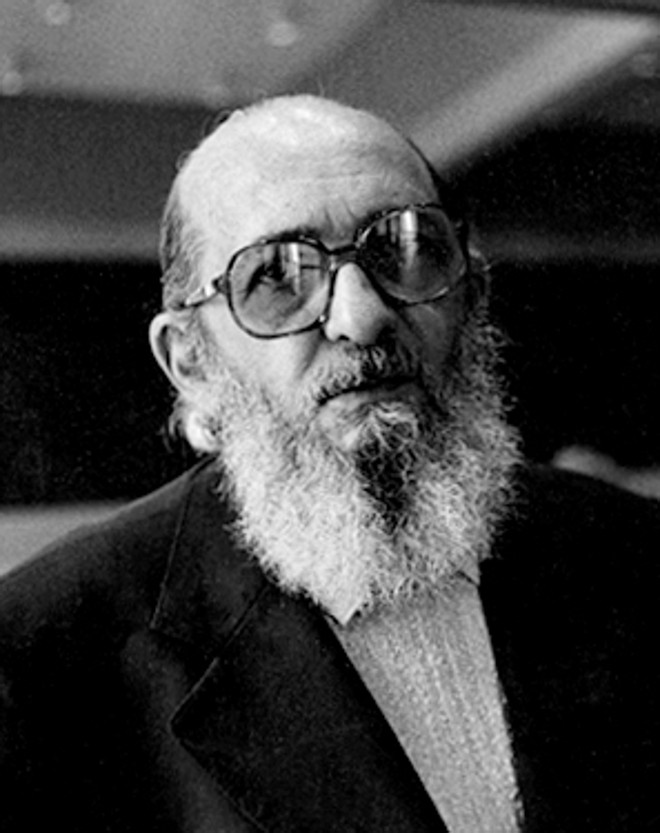
Paulo Freire
1921 – 1997 · Critical Pedagogy · Liberation Education
The most influential philosopher of education of the 20th century. Freire’s Pedagogy of the Oppressed argued that traditional schooling deposits knowledge into passive students — an act of oppression. His concept of “conscientization” and praxis (reflection + action) transformed education into a political and liberatory practice. His work is foundational to Kaupapa Māori theory.
“Education either functions as an instrument which is used to facilitate integration of the younger generation into the logic of the present system and bring about conformity or it becomes the practice of freedom.” — Paulo Freire, Pedagogy of the Oppressed (1968)
🧑🎓 Biography & Historical Context
Paulo Reglus Neves Freire was born in 1921 in Recife, Brazil to a middle-class family that fell into poverty during the Great Depression — an experience that permanently shaped his identification with the marginalised. He trained as a lawyer but never practised, turning instead to education and working with illiterate peasants and factory workers in rural northeast Brazil through a literacy programme that was explicitly and necessarily political.
Freire’s literacy work drew on generative themes — words drawn from participants’ own realities and struggles. The programme was extraordinarily effective: illiterate adults could learn to read and write in weeks rather than years, because the words they were learning meant something to their actual lives. After the 1964 military coup in Brazil, his work was deemed subversive, he was arrested, and then exiled.
Freire wrote Pedagogy of the Oppressed (1968) while in exile in Chile, working with the Chilean land reform movement. It was banned in Brazil for years. He later worked with the World Council of Churches in Geneva, travelled widely, returned to Brazil in 1980, and served as Secretary of Education for São Paulo 1989–1991. He died in 1997, the same year as his friend and fellow radical educator, Ivan Illich.
💡 Banking Education vs Problem-Posing Education
| Banking Education | Problem-Posing Education |
|---|---|
| Teacher narrates; students listen. | Dialogue: both teacher and student learn. |
| Students are receptacles; teacher deposits knowledge. | Students are co-investigators of reality. |
| Curriculum is fixed; knowledge is given. | Curriculum emerges from students’ own generative themes. |
| Reproduces existing social relationships and power structures. | Develops critical consciousness; students become agents of change. |
| Students adapt; they do not question. | Students transform the world through praxis: reflection + action. |
🔵 Core Concepts
🌿 Foundational Influence on Kaupapa Māori
Freire’s framework is explicitly foundational to Kaupapa Māori theory. Professor Graham Smith (Ngāti Apa, Ngā Puhi) credits Freire alongside Antonio Gramsci as two of the primary theoretical antecedents for his 1997 PhD thesis on Kuapapa Māori: Theory and Praxis. Linda Tuhiwai Smith’s Decolonizing Methodologies (1999) also builds on Freirean praxis in its framework for indigenous research.
The concept of banking education maps precisely onto the experience of Māori students in mainstream schools — where Māori knowledge is treated as supplementary decoration on a Eurocentric curriculum, and Māori students are positioned as passive recipients of Pākehā epistemology. Freire’s analysis makes this structural: it is not a matter of individual teachers’ prejudice but of how schooling itself functions to reproduce inequality.
New Zealand Social Studies curriculum explicitly builds in critical thinking, social inquiry, and social action — all Freirean legacies. The strongest Māori education initiatives (kōhanga reo, kōhanga nest, wānanga) can be read as Freirean problem-posing education rooted in Māori generative themes.
bell hooks and Elizabeth Ellsworth critiqued Freire for a masculinist, universalising approach that overlooks patriarchy and assumes a single unified “oppressed” group. Ellsworth’s “Why Doesn’t This Feel Empowering?” (1989) is essential reading. Indigenous scholars also note that Freire’s framework, while generative, operates within Western European philosophy and may not fully account for indigenous ontologies — in particular, the relational, genealogical, and land-based ways of knowing that do not fit a subject/object binary.
🏫 Classroom Implications
- Start with students’ actual lives — not textbook content. Ask what matters in their communities. Design curriculum around the real questions and contradictions students face, not pre-packaged units.
- Design dialogic classrooms — Socratic seminars, deliberative discussions, student-led inquiry. Create space for genuine dialogue where you, the teacher, are also a learner.
- Include action in social inquiry — social justice education without action is only awareness. Build in community research, letter-writing, presentations to decision-makers, or advocacy projects.
- Examine whose knowledge your curriculum privileges — whose stories, whose history, whose ways of knowing are represented? Whose are absent or marginalised? Name this with students.
- Critique banking practices in your own school — do assessments require memorisation of received knowledge, or critical engagement with real problems? Are Māori students positioned as knowledge-holders or knowledge-recipients?
- Model intellectual humility — Freire said the teacher who does not learn from students is not teaching but depositing. Share your own uncertainties, contradictions, and ongoing learning with students.
📚 Academic References
-
Freire, P. (1968/1970). Pedagogy of the Oppressed. Continuum/Bloomsbury. (Original Portuguese:
Pedagógica do Oprimido)
🎓 Google Scholar ↗ -
Freire, P. (1998). Pedagogy of Freedom: Ethics, democracy, and civic courage. Rowman &
Littlefield.
🎓 Google Scholar ↗ -
hooks, b. (1994). Teaching to Transgress: Education as the Practice of Freedom. Routledge.
🎓 Google Scholar ↗ -
Ellsworth, E. (1989). Why doesn’t this feel empowering? Working through the repressive myths of
critical pedagogy. Harvard Educational Review, 59(3), 297–324.
🎓 Google Scholar ↗ -
Smith, G. H. (1997). The development of Kaupapa Māori: Theory and praxis [PhD thesis].
University of Auckland.
🎓 Google Scholar ↗ -
Tuhiwai Smith, L. (1999). Decolonizing Methodologies: Research and Indigenous Peoples. Zed Books /
University of Otago Press.
🎓 Google Scholar ↗
Mātauranga Māori Lens
Freire's critique of the "banking model" — students as empty vessels filled with the teacher's knowledge — is one of the most powerful articulations of what kaupapa Māori educators describe as the colonial classroom. In Aotearoa, the banking model filled Māori students with Pākehā content while systematically emptying them of mātauranga Māori, te reo, and tikanga. The historical damage of this is not abstract — it is in the data on educational disparity that persists today.
His concept of conscientisation — the critical awakening through which people recognise the structures that constrain them — parallels the kaupapa Māori concept of mana motuhake: reclaiming the right to define oneself and one's community. Freire's praxis (reflection + action) mirrors the wānanga tradition: thinking together leads to collective responsibility for transformation. His insistence on starting from the learner's actual lived reality — not an abstracted curriculum — is the foundation of tikanga-based teaching: the learner's whakapapa, community, and lived experience are not context for learning, they are the content.
🌿 Use this in classroom
Apply Freire's "generative theme" approach in NZ: find the genuine tensions and questions that matter to your ākonga community (land rights, climate, identity, economic inequality) and build curriculum from those. For Māori students, kaitiakitanga is not a topic — it is a generative theme. Whanaungatanga in the classroom is the environment that makes conscientisation possible: students will not take intellectual risks in rooms where their mana is not protected.