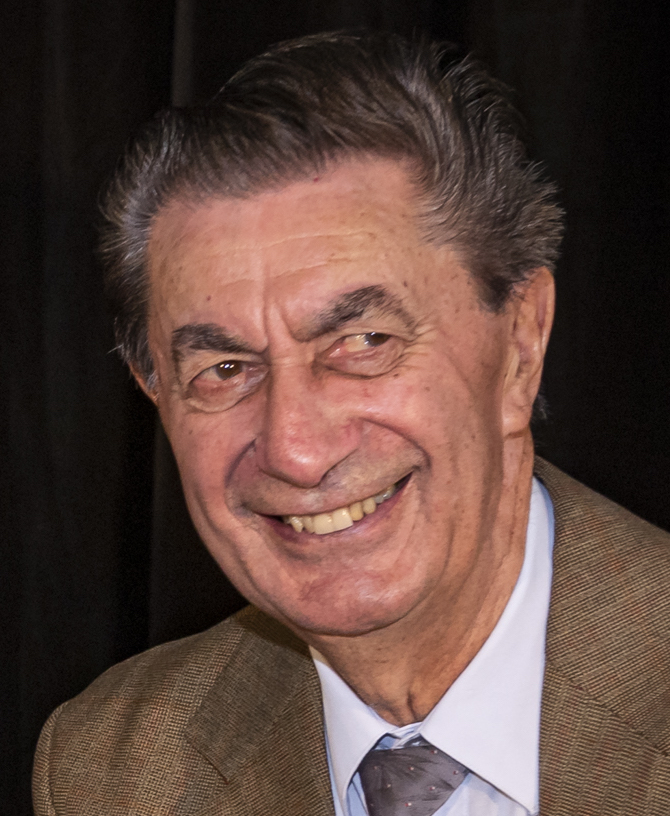
🌿 Angus Macfarlane
Photo: Royal Society Te Apārangi · CC BY 3.0
Who Is He?
Professor Angus Hikairo Macfarlane (Ngāti Māhuta, Tainui) is one of Aotearoa's foremost Māori educational psychologists and a foundational figure in culturally responsive pedagogy. A Professor of Māori Research at the University of Canterbury, his scholarship bridges kaupapa Māori, educational psychology, and special education.
Macfarlane's work is defined by its dual focus: making mainstream education genuinely responsive to Māori learners, and ensuring that Māori cultural knowledge is not merely tokenised but structurally embedded in how schools function, how teachers relate, and how students are supported.
🌿 Why This Matters in Aotearoa
Macfarlane's research emerged directly from the persistent achievement gap between Māori and non-Māori students — not as a problem located in students or families, but as a systemic failure of schools to engage authentically. His work provides both the theoretical framework and practical tools for change.
Key Contributions
- The Educultural Wheel — A framework synthesising five dimensions of culturally responsive practice: tino rangatiratanga (self-determination), whakapapa (relationships and identity), manaakitanga (care and reciprocity), kotahitanga (inclusion and solidarity), and ako (reciprocal learning). Each dimension applies directly to classroom practice.
- Te Kotahitanga Research (with Russell Bishop) — Co-contributor to the groundbreaking Te Kotahitanga project, which demonstrated that changing teacher-student relationships (not deficit remediation) was the most powerful lever for Māori student achievement.
- Special Education in Aotearoa — Pioneering work on culturally responsive practices within special education — interrogating how disability and learning support frameworks inherited from Western models may clash with Māori worldviews.
- Hikairo Schema — A behavioural support framework built on Māori values, providing culturally grounded alternatives to Western behaviour management models.
- Culturally Responsive Leadership — Work on how school leaders can build institutions where Māori staff, students and whānau are genuinely included and empowered.
The Educultural Wheel in Detail
Macfarlane's most widely applied framework, the Educultural Wheel, provides a practical vocabulary for teachers doing the work of cultural responsiveness. It is grounded in Māori values but framed in accessible, classroom-ready terms:
Tino Rangatiratanga — Self-Determination
Students exercise agency over their learning. Teacher practices honour student voice, provide genuine choice, and avoid structures that position Māori students as passive recipients of education. In the classroom: student-led inquiry, negotiated learning goals, genuine participation in assessment design.
Whakapapa — Identity and Relationships
Every student comes with a lineage of knowledge, culture, and identity. Effective teachers know their students — not just academically, but culturally and relationally. In the classroom: knowing students' names, mahi, iwi, and what matters to their whānau.
Manaakitanga — Care and Reciprocity
Genuine care — not performative warmth but practical, consistent action in the interest of students. This is unconditional: it does not depend on students meeting teacher expectations first. In the classroom: following up, checking in, maintaining high expectations precisely because you care about the student's future.
Kotahitanga — Unity and Inclusion
Building genuine belonging — not surface-level inclusion that places Māori students in mainstream settings while ignoring their cultural identity. In the classroom: cooperative learning structures, explicit celebration of Māori knowledge, addressing exclusion and racism when it occurs.
Ako — Reciprocal Learning
The teacher learns from the student as the student learns from the teacher. Knowledge flows both ways. In the classroom: teachers who are genuinely curious about students' knowledge and experience, who adapt their practice based on what students bring.
Critical Analysis
Macfarlane's work is broadly celebrated within NZ educational research, but it is not without critique:
- Implementation gap: The Educultural Wheel is a framework for understanding — not a prescription. Teachers without adequate support or professional development may use the language without understanding or changing their practice.
- Systemic vs individual focus: Some critics argue that culturally responsive frameworks place too much responsibility on individual teachers without addressing structural and institutional factors (funding, curriculum design, school culture) that constrain teachers' ability to act.
- Intersection with disability: Macfarlane's work on special education has been particularly important in challenging Western-centric disability frameworks — but implementation in schools remains uneven.
Classroom Implications
- Audit your classroom against each Educultural Wheel dimension. Where are your genuine strengths? Where is there work to do?
- Do not wait for Māori students to bring cultural knowledge before you engage with it. Bring it into your curriculum planning proactively.
- Approach behaviour through a relational lens — before consequence, ask: what does this behaviour tell me about how this student is experiencing my classroom?
- Engage whānau as knowledge-holders, not just parents. What does a student's whānau know that would enrich your teaching of this unit?
Academic References
- Macfarlane, A. H. (2004). Kia hiwa rā! Listen to culture. NZCER Press.
🎓 Google Scholar ↗ - Macfarlane, A. H., Glynn, T., Cavanagh, T., & Bateman, S. (2007). Creating culturally safe
schools for Māori students. The Australian Journal of Indigenous Education, 36, 65–76.
🎓 Google Scholar ↗ - Bishop, R., Berryman, M., & Macfarlane, S. (2017). He Māpuna te Tamaiti: Supporting the
social and emotional competence of Māori children. NZCER Press.
🎓 Google Scholar ↗ - Macfarlane, A. H. (2009). Hikairo schema: Educating for life. In K. Mara (Ed.), Pacific
education. NZCER Press.
🎓 Google Scholar ↗