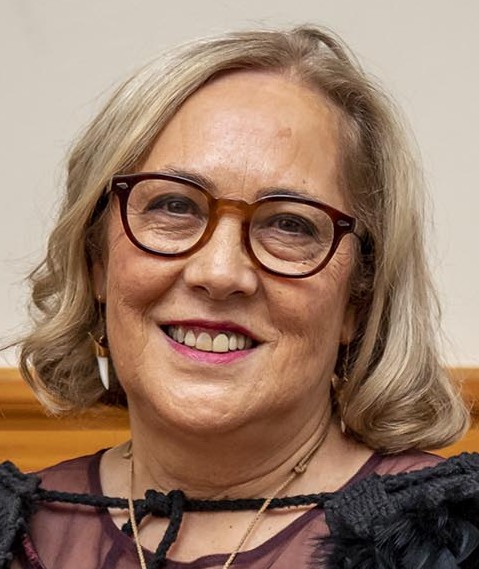
Linda Tuhiwai Smith
Dame Professor Linda Tuhiwai Smith · 1950– · Decolonizing Methodologies · Kaupapa Māori Research
The scholar who named what others felt but couldn’t articulate: that research itself had been a tool of colonialism, and that Indigenous peoples had both the right and the responsibility to reclaim knowledge on their own terms. Her work did not create a problem — it gave the problem its most precise and powerful language.
Photo: Royal Society Te Apārangi · CC BY 4.0
🧑🎓 Biography & Intellectual Journey
Dame Professor Linda Tuhiwai Smith was born in 1950, of Ngāti Awa and Ngāti Porou descent. She grew up in Taumarunui and studied at the University of Auckland, before beginning a career that would eventually transform how the world understands the relationship between research, knowledge, and power. For much of her academic life she was based at the University of Waikato, where she became Professor and eventually Foundation Dean of the School of Māori and Pacific Development — one of the first such schools at a New Zealand university. She later served as Pro-Vice Chancellor Māori, a role that took her from the lecture theatre to the boardroom of institutional change.
Her 1999 book Decolonizing Methodologies: Research and Indigenous Peoples is now in its third edition (2021) and has been cited more than 60,000 times — making it one of the most influential social-science texts produced anywhere in the Pacific, and a foundational reference in education faculties worldwide. But the number undersells the impact: this is a book that changed what researchers ask themselves before they begin. She developed Kaupapa Māori research alongside her husband Professor Graham Smith — a research tradition that insists Māori communities own, conduct, and benefit from research about Māori. In 2020 she was made a Dame Companion of the New Zealand Order of Merit (DNZM) for services to education and Māori people.
Smith has said that she wrote Decolonizing Methodologies for students from colonised communities who needed a language for what they already knew: that the research done about their people, by outsiders, with outsiders’ questions and outsiders’ frameworks, had not served them. That it had, in fact, regularly harmed them. The book’s endurance reflects how precisely it named something real.
🧭 Kaupapa Māori Research Principles
With Graham Smith, Tuhiwai Smith codified Kaupapa Māori as a research framework — not merely a method, but a set of values that govern the relationship between researcher and community. These four principles distinguish ethical research from extractive research:
🌏 Aotearoa NZ Resonance
Tuhiwai Smith’s work is not a theoretical import from overseas. It is deeply located in Aotearoa’s specific history: the Native Schools Act, the Tohunga Suppression Act, Te Kohiti survey processes that mapped Māori land for confiscation — all of these were exercises in research as extraction. The genealogy of harm she traces is not abstract. It happened here, in the communities of people who are in classrooms now.
Her influence is visible in Ka Hikitia (the Māori education strategy), in the Treaty of Waitangi obligations embedded in the New Zealand Curriculum, and in the shift toward culturally responsive pedagogy as an evidenced professional standard. Te Mātaiaho 2025 continues this trajectory — the revised curriculum’s insistence on knowing your students, their whakapapa, and their learning context is a direct heir to Smith’s argument that the researcher (or teacher) must position themselves, not claim neutral distance.
🌱 What This Means for Every NZ Teacher
You are, in a sense, a researcher every day. You collect information about students, interpret it, and make decisions based on it. Smith’s framework applies: whose knowledge counts as valid in your room? Who benefits from the assessments you run? Are your students positioned as knowledge-producers or knowledge-recipients? These questions have answers — and the answers have consequences for Māori and Pasifika ākonga in particular.
There is a productive paradox in Smith’s work that she has discussed openly: she wrote Decolonizing Methodologies in English, published by a British press (Zed Books), using academic citation conventions designed by and for Western universities. The critique of the master’s tools was itself written with the master’s tools. Smith’s answer — most explicitly in the third edition — is that you work within the available systems while building new ones; that reaching the academy on its own terms is a strategy, not a concession. But the tension is real and worth naming: the most radical decolonisation text in the field is also the most-cited. Academia absorbed it and called it scholarship. Whether that counts as a victory depends on what changes downstream.
🏫 Classroom Implications
- Audit your reading list for knowledge sovereignty Who wrote the texts you teach? Whose histories are centred and whose are absent? Smith’s question is not rhetorical — go through your unit reading list and mark the author’s identity, the knowledge tradition being represented, and who is missing. The gap is the curriculum work.
- Position students as knowledge-producers, not just recipients Community interviews, oral history projects, whakapapa mapping, local-knowledge investigations — these are not enrichment activities. They are the form of research that honours the knowledge students and their families carry. Build at least one such task into every unit.
- Apply the reciprocity question to every assessment Before you design an assessment, ask: who benefits from this? If the answer is “my gradebook,” revise. If students receive something of genuine value — insight, skill, documentation of their own knowledge — you are closer to Smith’s standard.
- Teach the 25 Indigenous Research Projects in senior Social Studies Smith’s typology — claiming, testimonies, storytelling, celebrating survival, remembering, and more — gives Year 11–13 students a framework for evaluating sources and understanding why some knowledge systems are documented and others were deliberately suppressed. It is one of the most generative critical thinking frameworks available for NZ history units.
- Model positionality yourself At the start of a unit, name where you stand: your whakapapa (if appropriate), your relationship to the content, what you don’t know. This is not self-indulgence; it teaches students that knowledge always comes from somewhere, and that transparency about that position is more honest than false objectivity.
- Use the community-benefit test for school-based research projects When students conduct inquiry, add a question: who benefits from this knowledge being gathered? If the answer is only the grade, the project has room to grow. Can findings be shared with the community? Can they address a real local question? Authentic audiences transform inquiry.
📚 Academic References
-
Tuhiwai Smith, L. (2021). Decolonizing Methodologies: Research and Indigenous Peoples
(3rd ed.). Zed Books. (First published 1999; the definitive reference — cite the
edition you read.)
🎓 Google Scholar ↗ -
Smith, G.H., & Smith, L.T. (1996). New mythologies in Māori education. In P. Spoonley,
D. Pearson, & C. Macpherson (Eds.), Ngā Patai. Dunmore Press. (Early
articulation of Kaupapa Māori research alongside Graham Smith.)
🎓 Google Scholar ↗ -
Tuhiwai Smith, L. (2005). On tricky ground: researching the native in the age of uncertainty.
In N. Denzin & Y. Lincoln (Eds.), The SAGE Handbook of Qualitative Research.
(The ethics of research-in-relationship; her most accessible entry point for classroom use.)
🎓 Google Scholar ↗ -
Smith, G.H. (1997). The Development of Kaupapa Māori: Theory and Praxis.
PhD thesis, University of Auckland. (Companion work; the theoretical architecture she
co-built with Graham Smith — read both together for the full framework.)
🎓 Google Scholar ↗ -
Ministry of Education. (2020). Ka Hikitia — Ka Hāpaitia: The Māori
Education Strategy. Ministry of Education, Aotearoa NZ. (The policy lineage
directly informed by Smith’s research tradition.)
🎓 Google Scholar ↗ -
Bishop, R., & Berryman, M. (2006). Culture Speaks: Cultural relationships and
classroom learning. Huia Publishers. (The empirical complement — what Smith
theorises about knowledge sovereignty, Bishop and Berryman evidence in classroom outcomes.)
🎓 Google Scholar ↗