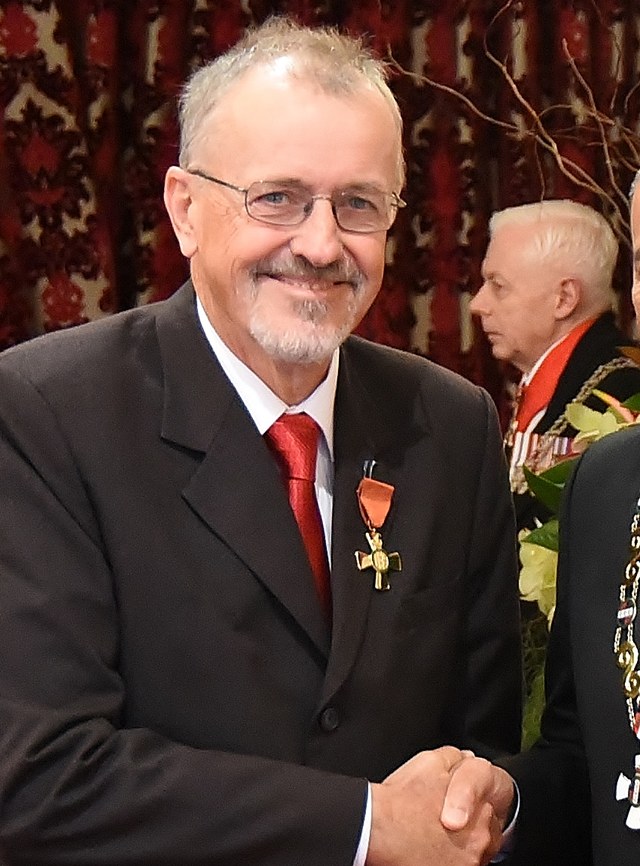
Russell Bishop
Contemporary · Culturally Responsive Pedagogy · Te Kotahitanga
Professor Russell Bishop is the co-architect of Te Kotahitanga — the most systematically evaluated culturally responsive professional development programme in New Zealand’s history. His work established the “deficit thinking” critique as a central concept in New Zealand teacher education: the recognition that teacher beliefs about Māori students’ capacity, rather than students’ actual capability, is the primary driver of the Māori achievement gap.
Photo: New Zealand Government, Office of the Governor-General · CC BY 4.0
“The solution to Māori students’ underachievement is to be found in changing teachers’ relationships with Māori students, not in attempting to change Māori students to fit the present school system.” — Russell Bishop, Te Kotahitanga Research (2003)
🧑🎓 Biography & Scholarly Context
Professor Emeritus Russell Bishop (Ngāti Awa) spent the majority of his research career at the University of Waikato, where he was Foundation Professor of Māori Education. His early research engaged with Māori community narratives and decolonising methodologies — work that culminated in his influential 1996 book Collaborative Research Stories: Whānau and Partnership in Research and directly influenced Linda Tuhiwai Smith’s landmark Decolonizing Methodologies (1999).
In the late 1990s, Bishop joined with Mere Berryman to launch the Te Kotahitanga research project. Beginning with the question “What do Māori students say about their own educational experiences?”, the research produced dozens of narratives that converged on a clear finding: the quality of the teacher-student relationship — and specifically whether teachers held high expectations — was the decisive factor above family background, socioeconomic status, or school resources.
This finding led Bishop and his colleagues to develop the Effective Teaching Profile (ETP) and a sustained professional development programme that has been implemented in over 400 schools. The programme is one of the few education interventions at scale in New Zealand to show statistically significant and sustained improvements in Māori student achievement.
🔴 Deficit Thinking: The Central Problem
Bishop’s single most important conceptual contribution to New Zealand education is his rigorous analysis and critique of deficit thinking — the tendency of teachers, schools, and systems to explain Māori underachievement through the perceived deficits of Māori students, families, and communities rather than through the failures of the education system itself.
- “These students don’t have good home support.”
- “Māori culture isn’t very academic.”
- “They just don’t value education.”
- “We have to be realistic about what these kids can achieve.”
- “The problem starts at home.”
- “How do I build whanaungatanga with this whānau?”
- “Whose culture does my curriculum centre?”
- “What are my genuine expectations for this student?”
- “What do I need to change to ensure this student succeeds?”
- “How am I partnering with whānau as co-educators?”
✨ The Effective Teaching Profile (ETP)
Based on Māori students’ own accounts of what constitutes effective teaching for them, Bishop and colleagues developed the ETP — seven interlocking characteristics of teachers who produce strong outcomes for Māori students:
- Manaakitanga — Creating a supportive and caring learning environment in the class. Teachers demonstrate genuine care for students as Māori people, not just as students.
- Whānau — Teachers develop a sense of family and community within the classroom — shared responsibility, mutual care, and belonging.
- Whakapiripiri — Working collaboratively, students help each other to learn through structured cooperative learning activities.
- Kotahitanga — Positioning students as co-constructors of curriculum, knowledge, and assessment criteria. Power is genuinely shared.
- Ako — Managing the classroom to maximise opportunities to learn. Learning relationships are reciprocal — teachers are also students.
- Whānau knowledge — Incorporating Māori knowledge, language, and cultural contexts as normalised elements of classroom discourse and curriculum.
- High expectations — Having high expectations for all students and taking responsibility for ensuring student achievement is realised. No deficit excuses accepted.
📋 Core Frameworks & Contributions
🌿 Significance for Aotearoa NZ
Bishop’s work transformed New Zealand education policy. Te Kotahitanga findings directly informed Ka Hikitia (Māori Education Strategy) and Tātaiako (Cultural Competencies for Teachers of Māori Learners). His deficit-thinking critique is now a standard element of ITE programmes throughout the country.
His most durable contribution may be methodological: the insistence on Māori student and whānau voice as the primary evidence base for education reform. Not government data, not standardised tests, not researcher frameworks — but the authentic accounts of the people most affected by the system. This is a Kaupapa Māori research principle made into policy.
Some critics have noted that Te Kotahitanga, while producing real gains, operated primarily within the existing mainstream schooling structure without fundamentally challenging its epistemological foundations. There is a tension between culturally responsive pedagogy — which adapts mainstream schooling for Māori students — and Kaupapa Māori education — which seeks to transform schooling from Māori values outward. Bishop’s work clearly acknowledges this tension; it should not be read as a final solution to structural inequity, but as a powerful, evidence-based intervention within existing structures while more fundamental transformation is sought.
🏫 Classroom Implications for Aotearoa Teachers
- Conduct a deficit thinking audit on yourself — In the last week, how have you explained a Māori or Pasifika student’s difficulty? Through their background, or through what you need to change in your teaching?
- Implement the ETP as a reflective framework — Rate yourself on each of Bishop’s seven characteristics. Which do you do well? Where is the growth edge?
- Listen to Māori students about their experience — Bishop’s entire programme began by genuinely asking Māori students what worked and didn’t. Have you asked your students?
- Share power in your classroom — let students co-construct rubrics, choose inquiry topics, design learning experiences. Kotahitanga is not teacher abdication — it is genuine intellectual partnership.
- Build genuine whānau relationships — this goes beyond formal parent interviews. It means learning students’ contexts, visiting communities, attending events, being known as someone who cares.
- Hold unconditional high expectations — the moment you make an exception for a Māori student because of their background, you have confirmed the deficit narrative. High expectations must be non-negotiable and backed by genuine support.
📚 Academic References
-
Bishop, R., & Glynn, T. (1999). Culture Counts: Changing power relations in education. Dunmore
Press.
🎓 Google Scholar ↗ -
Bishop, R., Berryman, M., Cavanagh, T., & Teddy, L. (2009). Te Kotahitanga: Addressing educational
disparities facing Māori students in New Zealand. Teaching and Teacher Education, 25(5),
734–742.
🎓 Google Scholar ↗ -
Bishop, R., & Berryman, M. (2006). Culture Speaks: Cultural relationships and classroom learning.
Huia Publishers.
🎓 Google Scholar ↗ -
Bishop, R. (1996). Collaborative Research Stories: Whānaungatanga. Dunmore Press.
🎓 Google Scholar ↗ -
Ministry of Education NZ. (2011). Tātaiako: Cultural Competencies for Teachers of Māori
Learners. Ministry of Education.
🎓 Google Scholar ↗