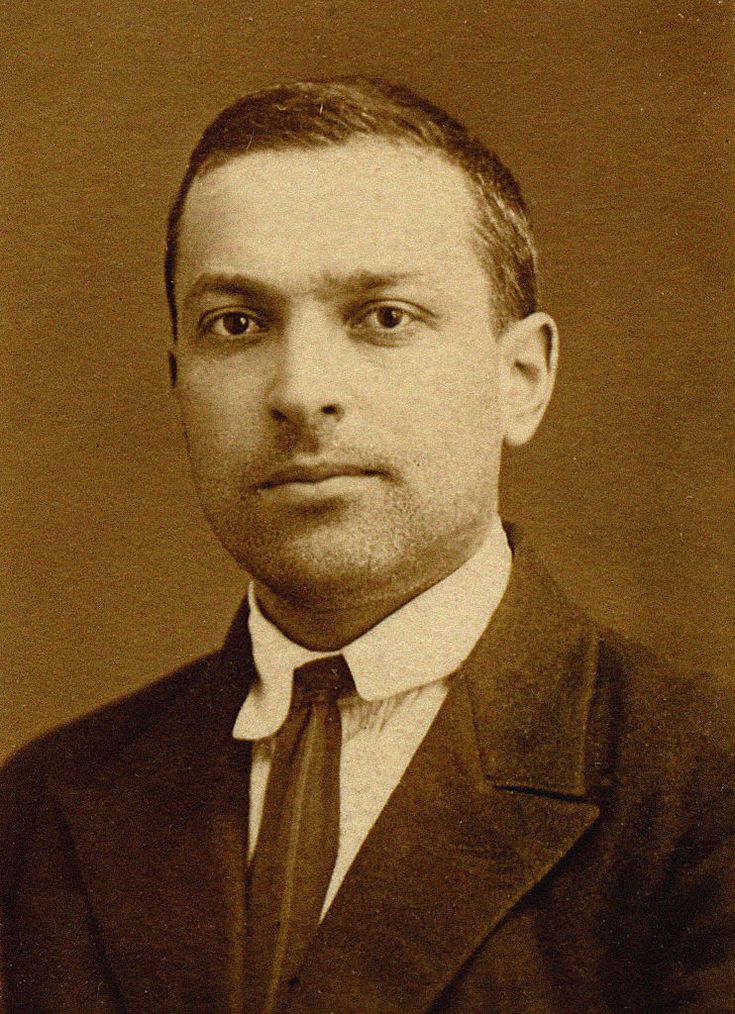
Lev Vygotsky
1896 – 1934 · Social Constructivism · Developmental Psychology
The foundational theorist of social learning. Vygotsky argued that all higher cognitive functions appear first between people before they appear within the individual — that learning is inherently relational, dialogic, and culturally embedded. His work, suppressed under Stalin and only translated into English in 1962, became the bedrock of constructivist pedagogy worldwide.
“What children can do with the assistance of others might be in some sense even more indicative of their mental development than what they can do alone.” — Lev Vygotsky, Mind in Society (1978, posthumously published)
🧑🎓 Biography & Historical Context
Lev Semyonovich Vygotsky was born in 1896 in what is now Belarus to a middle-class Jewish family. He studied law, literature, and philosophy before turning to psychology — never receiving formal training in the field — and brought extraordinary interdisciplinary breadth to his work. He died of tuberculosis at just 37, yet produced an enormous body of scholarship in barely a decade.
Vygotsky worked during the early Soviet period when psychology was caught between Marxist materialism and Western behaviourism. His major works — including Thought and Language and Mind in Society — were suppressed after his death and only published in English from 1962 onwards, influencing a second generation including Jerome Bruner, who extended his ideas into the concept of scaffolding.
His rediscovery was historically significant: it coincided with the 1970s–80s paradigm shift away from behaviourism toward constructivism. He offered educators a powerful alternative: learning is not what happens inside an isolated individual but what happens between people.
🔵 Core Concepts
The Zone of Proximal Development (ZPD) is "the distance between the actual developmental level as determined by independent problem solving and the level of potential development as determined through problem solving under adult guidance or in collaboration with more capable peers."
🌿 Aotearoa NZ Resonance
Vygotsky's framework resonates deeply with tikanga Maori in ways that are not coincidental — both centre the social, relational, and dialogic nature of learning:
- Tuakana-teina: The tradition of older/more experienced learners supporting younger/newer ones is a direct cultural implementation of the MKO concept.
- Wananga: Traditional Maori knowledge transmission through collective dialogue aligns with Vygotsky's view that knowledge is social before it is individual.
- Ako: The Maori concept of reciprocal teaching and learning — where teacher and learner roles are fluid — resonates with Vygotsky's non-hierarchical view of learning relationships.
- Te reo Maori: Vygotsky's insight that language is the primary cognitive tool provides powerful justification for immersion: te reo does not just preserve culture — it develops different and expanded cognitive structures.
Vygotsky wrote from within a European, Russian context. His ZPD assumes a linear developmental trajectory that may not reflect the spiral, collective, and place-based nature of indigenous knowledge acquisition. Kaupapa Maori scholars argue that the MKO model underplays the role of whakapapa and ancestral knowledge as sources of guidance. Use Vygotsky as a complement to, not a replacement for, indigenous frameworks.
🏫 Classroom Implications
- Assess the ZPD before planning — know what students can do independently before designing tasks. Tasks too far above or below the ZPD waste learning time.
- Use tuakana-teina deliberately — pair or group students so more capable learners scaffold others, rotating roles so everyone is sometimes the tuakana.
- Make thinking audible — think aloud as you model. Verbalising cognitive process demonstrates inner speech and supports students to develop their own metacognitive self-talk.
- Design tasks that require dialogue — projects, debates, Socratic seminars, collaborative problem-solving. Learning that requires talking is learning that moves from social to internal.
- Remove scaffolding gradually — scaffolding left in place too long creates dependence. Plan the fading of support as a deliberate pedagogical strategy.
- Value te reo as cognitive tool — for bilingual students, switching between languages is not confusion — it is cognitive flexibility. Translanguaging is a strength, not a deficit.
📚 Academic References
-
Vygotsky, L. S. (1978). Mind in Society: The development of higher psychological processes. Harvard
University Press.
🎓 Google Scholar ↗ -
Vygotsky, L. S. (1986). Thought and Language. MIT Press. (Original work 1934)
🎓 Google Scholar ↗ -
Wood, D., Bruner, J. S., & Ross, G. (1976). The role of tutoring in problem solving. Journal of Child
Psychology and Psychiatry, 17(2), 89–100.
🎓 Google Scholar ↗ -
Daniels, H. (Ed.). (2005). An Introduction to Vygotsky (2nd ed.). Routledge.
🎓 Google Scholar ↗ -
Bishop, R., & Berryman, M. (2006). Culture Speaks: Cultural relationships and classroom learning.
Huia Publishers.
🎓 Google Scholar ↗