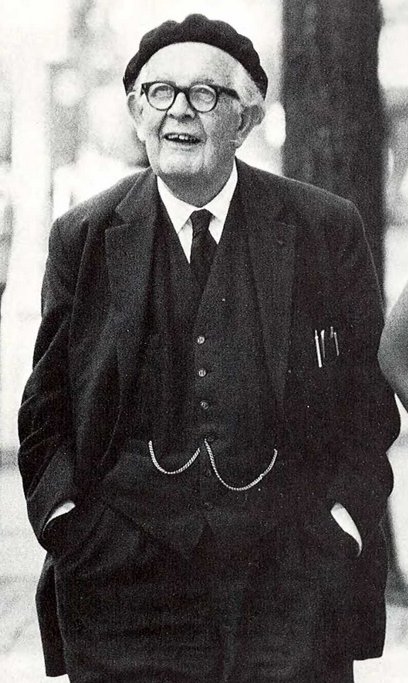
Jean Piaget
1896 – 1980 · Cognitive Constructivism · Developmental Psychology
Piaget fundamentally changed how we understand child development by insisting that children are not miniature adults but active constructors of knowledge who move through qualitatively different stages of cognitive development. His theory of constructivism — that learners build understanding through direct experience and interaction with the world — remains one of the most generative ideas in educational psychology.
“The goal of education is not to increase the amount of knowledge but to create the possibilities for a child to invent and discover, to produce people who are capable of doing new things.” — Jean Piaget
🧑🎓 Biography & Context
Jean Piaget was born in Neuchâtel, Switzerland in 1896. A remarkably precocious scholar, he published his first scientific paper — an observation of an albino sparrow — at age 10. Trained in biology and zoology at the University of Neuchâtel, his biological background permanently shaped his view of intelligence as an adaptive biological function: as organisms adapt to their environment, so do minds.
After completing his PhD in natural sciences, he turned to psychology, spending time at Alfred Binet’s intelligence testing laboratory in Paris. Crucially, he became fascinated not by the correct answers children gave but by the wrong ones — what patterns of error could reveal about the structure of children’s thinking. This insight — that errors are windows into cognition, not failures — was foundational.
Piaget spent his career at the International Centre for Genetic Epistemology in Geneva. His theory was developed through careful, naturalistic observation — particularly of his own three children — and through clinical interviews. He was not an educator himself; his concern was describing how knowledge structures develop, not how to teach. His work was popularised in English-speaking education primarily by Jerome Bruner in the 1960s.
🧠 Core Theory: How Learning Happens
📈 Four Stages of Cognitive Development
Note: These ages are averages and culturally variable. Treat as tendencies, not rigid milestones. Margaret Donaldson (1978) and cross-cultural research have substantially complicated Piaget's stage timing.
🌿 Aotearoa NZ Context
Piaget’s constructivism shaped New Zealand primary curriculum design, particularly in Science and Mathematics, where hands-on, material-based learning is prioritised in early years. The emphasis on students constructing their own understanding — rather than receiving it — is embedded in the NZC’s key competencies and the vision for capable learners.
However, Piaget’s theory of learning through direct manipulation of objects resonates strongly with traditional Māori learning practices: learning through doing, through participation in community activities, through kaitiakitanga (environmental stewardship), weaving (whare raranga), carving (whakairo), and other practices where abstract knowledge is always grounded in embodied, hands-on engagement.
Piaget’s stages have been substantially revised. Margaret Donaldson’s Children’s Minds (1978) demonstrated that children reason at higher levels than Piaget claimed when tasks have “human sense” — when they are embedded in meaningful social contexts rather than decontextualised laboratory tasks. Cross-cultural research shows that stage achievement is culturally variable and shaped by formal schooling. Vygotsky’s critique — that Piaget undervalues the role of social interaction and language — remains powerful. Piaget’s individual child constructing knowledge in isolation is an artefact of his Western, middle-class, laboratory-based research context.
🏫 Classroom Implications for Aotearoa Teachers
- Concrete before abstract, always — in mathematics especially, use manipulatives (blocks, counters, tens-frames, place value equipment) before moving to symbolic notation. This is not just for younger students.
- Create cognitive conflict deliberately — tasks that produce disequilibrium are motivating. Show students two different approaches; ask which is right and why. Let the puzzle drive learning.
- Take wrong answers seriously — ask students to explain their reasoning when they give an incorrect answer. Often it reveals a perfectly logical schema that just needs expanding — not a failure to be corrected.
- Design tasks appropriate to developmental stage — but treat stages as tendencies. A student in Year 5 who cannot yet do formal-operational reasoning is not behind — they may need more concrete experience.
- Don’t rush abstraction — premature abstract instruction, before concrete foundations are solid, creates brittle understanding that collapses under novel problems.
- Hands-on learning is cognitively serious — playing with materials, building models, doing experiments, working with tools — this is how learning happens, not a break from learning.
📚 Academic References
-
Piaget, J. (1952). The Origins of Intelligence in Children. International Universities Press.
(Original French 1936)
🎓 Google Scholar ↗ -
Piaget, J., & Inhelder, B. (1969). The Psychology of the Child. Basic Books.
🎓 Google Scholar ↗ -
Donaldson, M. (1978). Children’s Minds. Fontana/Collins. [Critical revision of Piaget]
🎓 Google Scholar ↗ -
Bruner, J. S. (1960). The Process of Education. Harvard University Press.
🎓 Google Scholar ↗ -
Flavell, J. H. (1963). The Developmental Psychology of Jean Piaget. Van Nostrand.
🎓 Google Scholar ↗ -
Wood, D. (1988). How Children Think and Learn. Blackwell. [Piaget and Vygotsky synthesised]
🎓 Google Scholar ↗