Te Kete Ako / Te Kaupapa / The Venture / 2026
Teaching resources you can check before you trust.
He pūtaketanga ako mō Aotearoa, heonga mai i te tuhinga tūturu o te marautanga, ā, e tātariatia ana pūāhua-pūāhua — kaua e hanga. Ko te ako tūkura wātea katoa, kīhai he puka kaiwaho. An Aotearoa teaching platform where curriculum references are quoted from official source text and checked character by character, not generated. The teaching content is free to browse. You do not need an account to see whether any of this is true.
- Live and deployed
- Pre-revenue
- Free to browse
- Built in Aotearoa
01 / Te Mumura — The problem, and why now
Twenty minutes between classes
A secondary teacher planning tomorrow's lesson may have twenty minutes between classes. In that time they need something that fits the curriculum, fits the year level, fits the learners in front of them, and will not embarrass them in front of students, whānau or colleagues.
Generic AI is fast, but it is not a curriculum authority
It writes fluent text that can name an achievement objective which does not exist, or attach a senior assessment standard to a Year 9 class. The teacher carries that risk personally.
Official curriculum is authoritative but slow
It says what should be learned. It does not say how to teach a mixed-ability Year 10 class by Tuesday.
International material is abundant but misplaced
For a teacher embedding te ao Māori and local context responsibly, overseas material is not neutral. It is extra work, because it has to be unpicked before it can be used.
One wrong curriculum reference on a handout is a professional credibility problem, not a software bug.
Why now — two curricula in play
Aotearoa is mid-curriculum-transition. Te Mātaiaho is replacing the 2007 New Zealand Curriculum but is still arriving, and it is still confusing. Teachers are planning across both at once, and many still prefer the one they know.
So every existing resource's claim of "curriculum aligned" is in question right now, all at once, for every teacher in the country. That is exactly the moment generic AI answers fastest and is most often wrong.
Te Kete Ako carries both curricula, separately, and never blends them.
02 / Te Tātari — The check
Watch it check itself
A real achievement objective from the New Zealand Curriculum 2007, and what happens to it before a teacher ever sees it on a page.
Understand how systems of government in New Zealand operate and affect people’s lives, and how they compare with another system.
If it matches
It is shown on the resource, with the curriculum and the level named.
If it does not
It is removed. Not softened, not paraphrased, not hedged into something defensible.
Why it matters
A generated reference looks identical to a real one until a teacher is challenged on it.
- Go deeper
- How alignment works
- The source documents
03 / Te Huarahi — Product, and how to find it
117 unit plans, open to anyone
Not a prototype and not a mock-up. A teacher can open the unit browser right now, with no account, and see every unit across ten subjects and fourteen year levels. Term-long arcs, not loose worksheets: kaupapa, curriculum progression and classroom-ready resources that hold together.
The free layer removes the cost of finding.
Find from four directions
- Subject
- Year level
- Resource type
- Classroom need
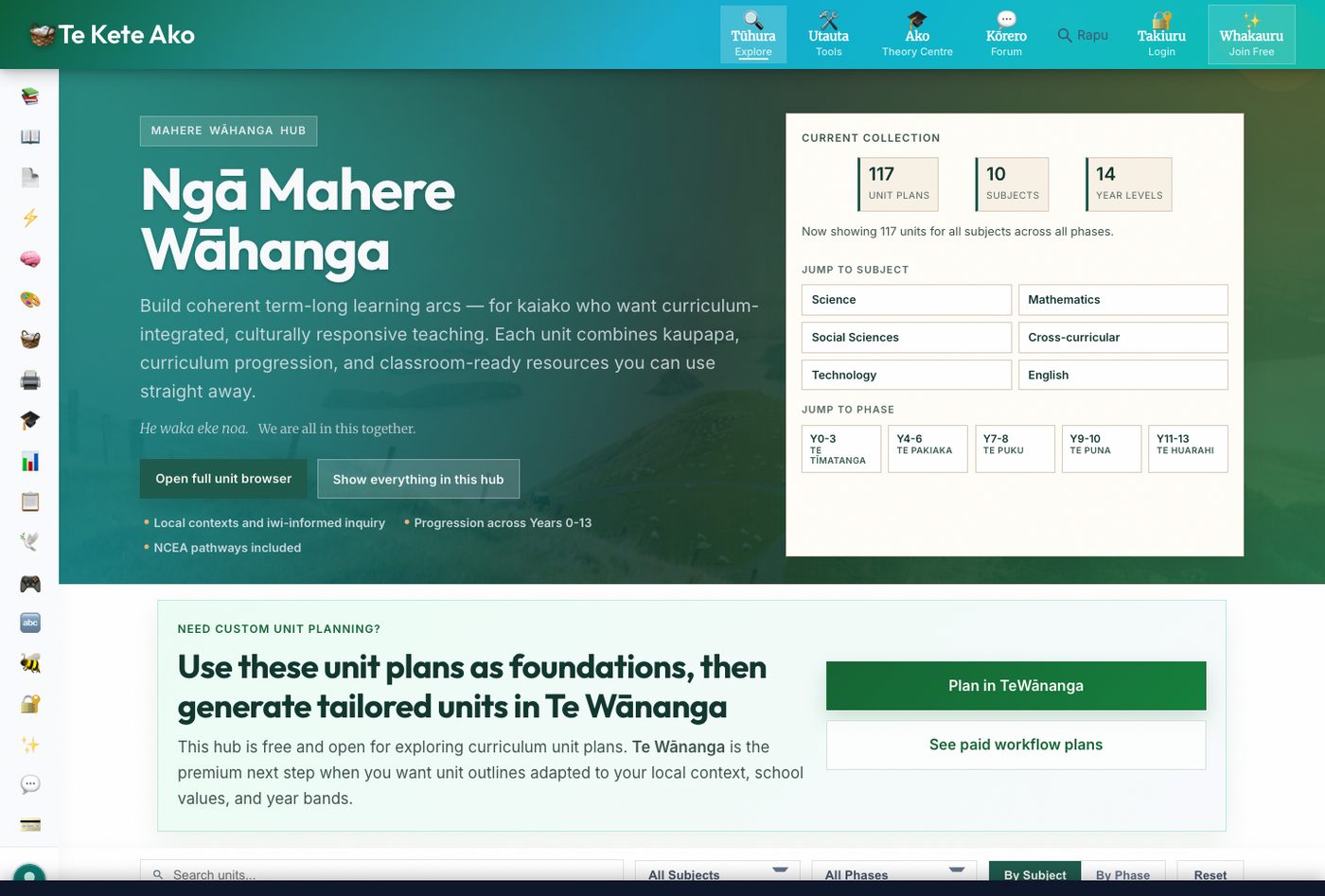
117 unit plans
no login wall
04 / Counted, not estimated
An estate, not a mock-up
- 4,877
- Teaching resources
- 117
- Unit plans
- ~900
- Lessons
- 5,932
- Curriculum statements
- 2,277
- Audited alignments
Verified against the live database on 9 August 2026. These numbers move, and when they move this page is wrong until it is corrected. That is the trade for stating them precisely instead of saying "thousands".
05 / Kua tīpakoia, kāore i te hanga — Retrieved, not generated
The authority comes from somewhere the AI does not invent
Generic models generate curriculum text. Te Kete Ako retrieves it. A curriculum statement shown on a resource is quoted from official source material and checked character by character against it. Where a match cannot be verified, the reference is removed rather than softened.
A deliberately unglamorous commitment, and the one teachers can feel.
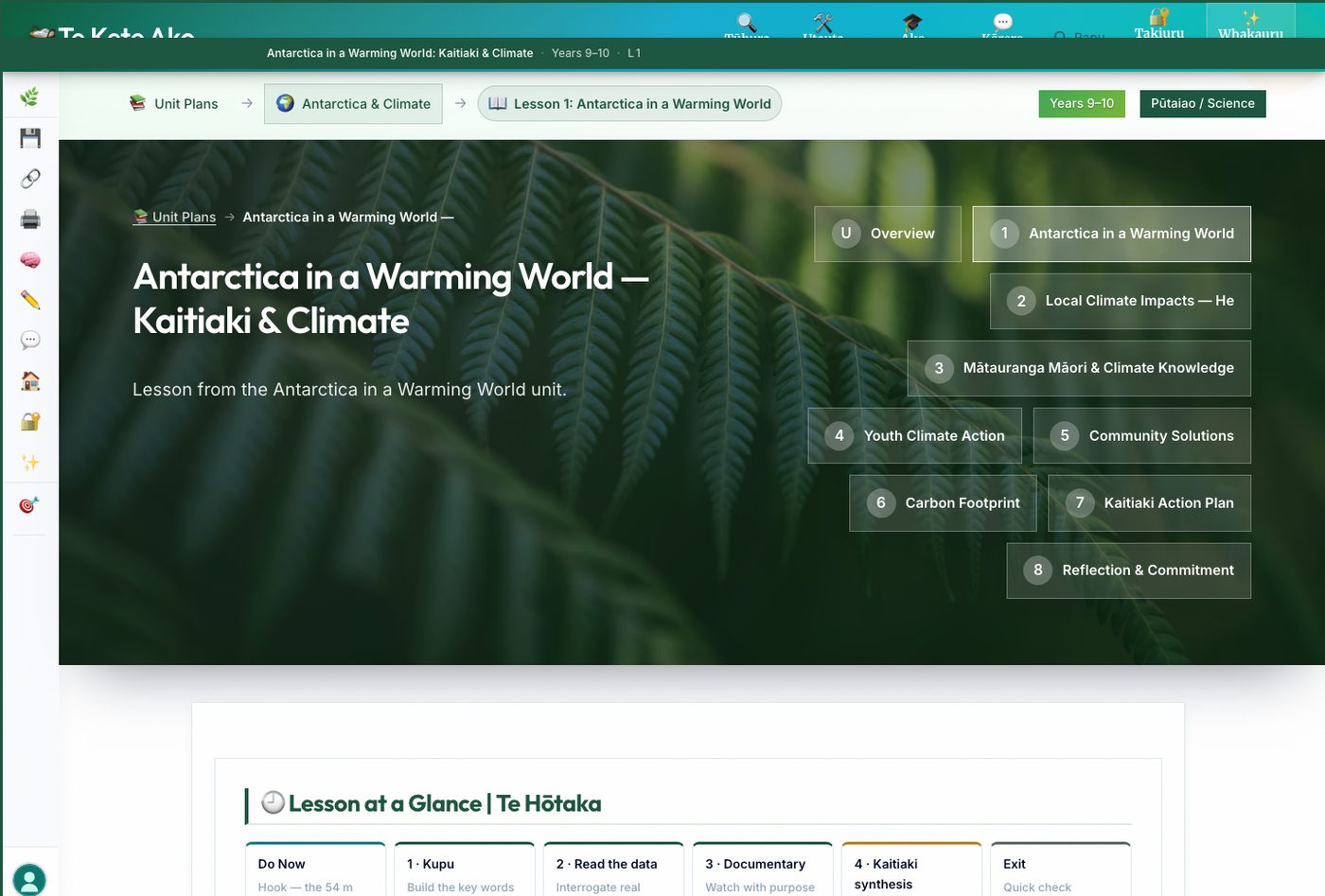
timed run sheet
8-lesson arc
The honest competitor set is not other EdTech. The row that matters is "source shown" — the only column a teacher can verify before they stake their credibility on a handout.
- Go deeper
- Check a unit yourself
- Handouts
06 / Te Arotake — The audit that counts against us
We caught ourselves being wrong
An internal audit found that a large share of Te Kete Ako's own curriculum alignment had been paraphrased or left unsourced rather than quoted. Not a competitor's product. Ours.
It was found, retired, and that layer was rebuilt against verified sources. It is on this page because it is the most useful thing we know: if a project with every incentive to look good can drift that way, teachers have good reason to distrust any tool that claims "curriculum aligned" without showing its source.
The verification machinery exists because we needed it ourselves first.
- Go deeper
- See the alignment layer
- Open a rebuilt unit
Built for these classrooms, in this country, by someone who has to teach in one on Monday.
Aotearoa New Zealand
07 / Te Aronga Tohu — The model
Free to view. Paid to work.
-
01
Open web — anyone
The teaching library is open, including to people with no account. A teacher has to be able to check this work before paying for any of it.
-
02
Kaiako Free — an account
Saving to a personal kete, and a monthly allowance of prints and downloads.
-
03
Kaiako Pro — professional workflow
Te Wānanga drafts a lesson from a plain-language description, Creation Studio refines it, and printing is unlimited. Prices are published on the pricing page.
Value comes from removing three costs from a teacher's week: finding, verifying and adapting. Only the third is charged for. The platform is pre-revenue, and nothing has been sold.
- Go deeper
- Pricing
- Te Wānanga
- Creation Studio
08 / Te Whānuitanga — Scale, sequenced by certainty
What would make this bigger than one person
At the current price, a few hundred subscribers is a working solo business, not a large one. Three things would have to become true to pass it, and each sits behind the one before.
-
Now · worth testing
Institutions follow teachers
Departments, schools and kura license once individual teachers already use and trust it. Never the other way around: a top-down sale to a school whose teachers have not chosen the tool is a renewal that does not come.
-
If true · contingent
The corpus becomes substrate
A verified, Aotearoa-specific curriculum corpus is exactly the layer a teacher-facing AI cannot generate for itself. If governed AI becomes the norm in classrooms, whoever holds the trustworthy local substrate is not in the same business as another chat wrapper.
-
Later · least proven
The machinery travels
The verification machinery is curriculum-agnostic. Other jurisdictions are too small for global publishers to localise honestly and have the same trust problem. This is the furthest-out hypothesis and the least proven.
None of the three is proven. Only the first is worth spending money on now, and saying so is the point: a plan that claims all three at once is not a plan.
- Go deeper
- What exists today
- Talk to me
09 / Te Kaihanga — The builder is the user
One person, who has to teach from it on Monday
Tobias McRae, completing a Graduate Diploma of Teaching (Secondary) at the University of Auckland, in Social Studies and Digital Technologies. Every lesson taught on placement is planned in Te Kete Ako. That is the whole design principle: the person building it is the person who has to teach from it, which closes a loop education technology usually leaves open.
- Go deeper
- About Te Kete Ako
- Get in touch
10 / Ngā mea e wātea ana — What is still open
Named, bounded, testable
A platform whose argument is verifiability does not get to be vague about its own gaps. Four unresolved truths, stated as a risk register: what we know, what remains open, and the evidence that would resolve it.
Willingness to pay
- Known
- Teachers use the platform to teach.
- Open
- None has been asked to pay.
- Next evidence
- An observed cohort conversion test.
Cultural authority
- Known
- Material needing kaumātua or kaiako Māori authority is flagged on authoring, not held back.
- Open
- That authority has not yet been formally reviewed.
- Next evidence
- Review via iwi approached for the purpose.
Accessibility & privacy
- Known
- Self-assessed against the standards we hold the content to.
- Open
- Self-assessed is not the same as independently reviewed.
- Next evidence
- External accessibility and privacy audit.
Search funnel
- Known
- Search demand is real and measurable.
- Open
- The funnel does not yet convert it.
- Next evidence
- Funnel instrumentation and a conversion experiment.
- Go deeper
- Judge it for yourself
- Tell me what is wrong
11 / Haere, tātaria — Go and check
Nothing here needs to be taken on trust
The library is open, the units are complete, and the curriculum references can be read against their sources.