📸 Evidence Collection
Two years of LAT teaching with measurable impact: In my first year (2024), my Year 8 class's literacy achievement rose by more than a stanine in approximately six months — tracked via asTTle and moderation. Below is evidence of my teaching practice across all six Standards: reflective writing, culturally responsive pedagogy, systems-thinking curriculum design, and academic achievement at A- or above. All student names are pseudonyms.
Goal-setting & critical reflection
I plan and review my practice deliberately, setting professional goals and reflecting against them using Gibbs' reflective cycle. My 2025 goals focused on being an excellent facilitator of learning, developing deep curriculum content knowledge, and building genuine rapport with my classes.
"I cannot be perfect, but I can be a good role model and an excellent facilitator of learning — and that is not enough; I want to be consistently great, not just occasionally excellent." — Personal goal reflection, 2025
"Developing rapport with classes is the hardest goal for me — it is three steps forward, one back. I have to keep earning it, every day, with every class." — Personal goal reflection, 2025 (whanaungatanga)
Artefacts: goal-and-reflection records; Gibbs reflective cycle framework. (Physical pages to be added — see below.)
Relationships before content
I greet every ākonga by name (pronounced correctly) and invest in relationships before content — the foundation Te Kotahitanga identifies as the precondition for engagement. "Kia ora Matua" became the most frequent greeting I heard on campus.
One moment captures the stance. Early in my first week, after a fight ended lunch abruptly, I was asked to gather frightened, wandering ākonga into a music room. A very small, silent Year 9 student stood terrified. Rather than press her to talk, I sat at the piano and played — the atmosphere shifted at once. She crept up, transfixed, and I coaxed her note by note until she whispered the only words she spoke all session:
"I really like it." — a Year 9 ākonga, after being taught her first notes
It reminded me that there are opportunities to teach in all aspects of this role, and what a privilege it is to share potentially life-changing moments with ākonga.
Elevating ākonga voices & identities
A central strategy in my practice is facilitating open, Socratic discussions that draw out and elevate ākonga's own cultural knowledge — making identity a curriculum asset and directly countering deficit thinking (Bishop & Berryman, 2009; Paris, 2012).
In my very first class, exploring "what is culture, and why does it matter?", the discussion opened up the moment a student from a minority background offered an answer I championed enthusiastically — suddenly the whole class "clicked" and contributions came flooding in. I invited overseas-born ākonga to share what they miss from home, framed culture as a source of strength, and handed the discussion to student leaders to carry. Across the year I wove students' cultures into the room — a student wrote a Kiribati idiom in place of the daily whakataukī — and used Te Tiriti, taught early and across units, as one of many bridges into their lived world.
Linked academic evidence: CIA Part 1 — Student Engagement · Film Analysis (Te Kotahitanga lens)
Te reo Māori & tikanga in practice
I am committed to teaching with — and continuing to learn — te reo Māori. I introduce myself to classes and colleagues with my own pepeha, and I plan lessons assuming a fluent speaker is present, inviting ākonga to correct me. Te reo is woven through my everyday classroom kupu:
"Whakarongo mai · Ka pai, ākonga · E tū whānau / E noho tauira · Rite tonu / rerekē · Aroha mai e hoa · Ngā mihi nui · Kia ora kōrua" — everyday classroom kupu
My tikanga knowledge includes the story of Tūrangawaewae Marae (built by Te Puea Hērangi, at the heart of the Kīngitanga) and the concept of tūrangawaewae as "a sense of place" — which I built into a lesson for the Tūrangawaewae me te Kaitiakitanga standard.
Artefact: Māori 403 formative assessment — pepeha, pronunciation, classroom kupu, and tikanga. Full pepeha available on request.
Units I designed and taught
"Design Your Own Society" (Year 9 Social Studies)
My strongest unit: adapted from an Ontario (Canada) curriculum unit to the Aotearoa context. In groups, ākonga imagined and designed a nation as a system, choosing a governance model (liberal democracy, dictatorship, tino-rangatiratanga communitarianism, oligarchy…) and understanding it well enough to present and defend. Groups then peer-presented, rated, and questioned each other's systems — genuine systems thinking, with work well beyond expectation.
Free-form, student-chosen novel study (Term 4)
Designed in response to student voice after other classes had disengaged from a set novel. Ākonga chose their own text (with my approval) and wrote about anything but plot, with ample scaffolding. All drafting happened in class, in their pukapuka — protecting authenticity and academic integrity in an AI era.
Other units
Te Tiriti o Waitangi (taught early in the year, anchored to Waitangi Day); Year 8 Systems, Government & Organisations; a Tūrangawaewae lesson built for the Tūrangawaewae me te Kaitiakitanga standard.
My Social Studies teaching philosophy
I want junior Social Studies to do more than march chronologically through "what happened" and "when." My focus is social inquiry and informed social action — moving ākonga toward the deeper "how?" and "why?" questions, building inquiry skills through a culturally responsive, skills-focused approach, and supporting them to take collective, informed action on issues that matter to them.
Linked academic evidence: EDCURSEC 692 — Lesson Design (Rights & Participation)
Primary evidence (the real artefacts)
Raw teaching artefacts behind the reflections above — presented as-is. Primary evidence is often unpolished, and that's the point: it's the genuine article.
📄 Unit task design — "Create Your Society"
My own Year 9 unit brief: worldview learning goals (Te Mātaiaho SocS.4.1 / 4.2 / 4.4), five group scenarios (geography · contact · ideas & knowledge), and the presentation + reflection checklist. Download the unit (PDF) ↗
📄 More teaching artefacts
- Unit overview — Systems & Government (Project-Based Inquiry) ↗
- PEEL writing exemplar — regular physical activity ↗
- PEEL writing exemplar — reducing plastic waste ↗
- Semiotics teaching resource ↗
🎓 Observer feedback — classroom observation (Term 2 2025)
"It is clear that you have invested so much in getting to know your students and building trust with them. Well done… The content and the high expectations that you have for the students — believing in them will make them rise to your expectations." — Observing mentor, formal classroom observation
Student work samples — Design Your Own Society student outputs (including the "Zazatown" governance system with complete government, economy, and policy structures) and classroom inquiry evidence are detailed and linked in my CIA Part 1 literature review and CIA Part 2 reflective inquiry, where I analyse both the theoretical foundations and pedagogical strategies behind student engagement.
Assessed work & marker feedback
My Graduate Diploma assessments — every graded item to date sits at A- or above — provide independent, marked evidence of my pedagogical thinking. Each linked page now includes the marker's feedback.
- CIA Part 2 — Inquiry Portfolio & Reflections — Ready to Submit
- CIA Part 1 — Student Engagement — 97.5% (A+)
- Film Analysis — Two Cars, One Night — 100% (A+)
- Bronfenbrenner Eco-map — 86.5% (A)
- Kōrero Ngaio — Collegial Discussion — 100% (A+)
- Motivation & Engagement Discussion — 83.3% (A-)
- Lesson Design — Rights & Participation — 80% (A-)
Te Kete Ako — the platform I built
Evidence of curriculum development capability beyond a single classroom: I designed and built Te Kete Ako, an open educational platform for Aotearoa teachers, now holding ~4,000 curriculum-aligned resources across 57+ unit plans — built by a practising kaiako, for kaiako.
Physical artefacts & classroom evidence
Photographed evidence from my classroom practice and collegial recognition. Student and staff names are pseudonymised for privacy.
Student Work Samples (PDF)
Designed national systems, representative models, rotating leadership, and sustainable policies. Pseudonymised.
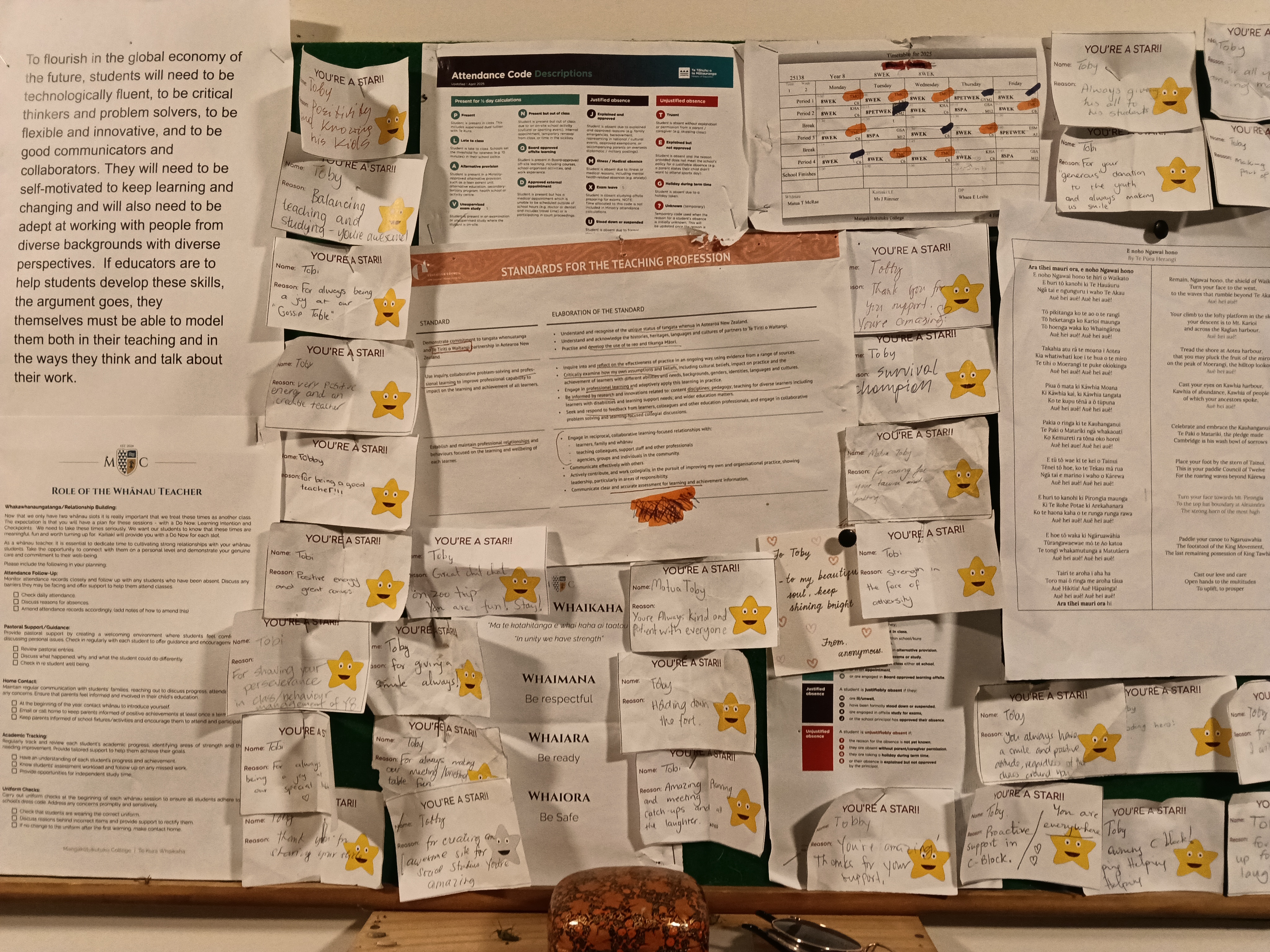
Toby's Commendation Board
My staffroom recognition wall at Mangakōtukutuku College, filled with "You're a Star" notes from fellow kaiako.
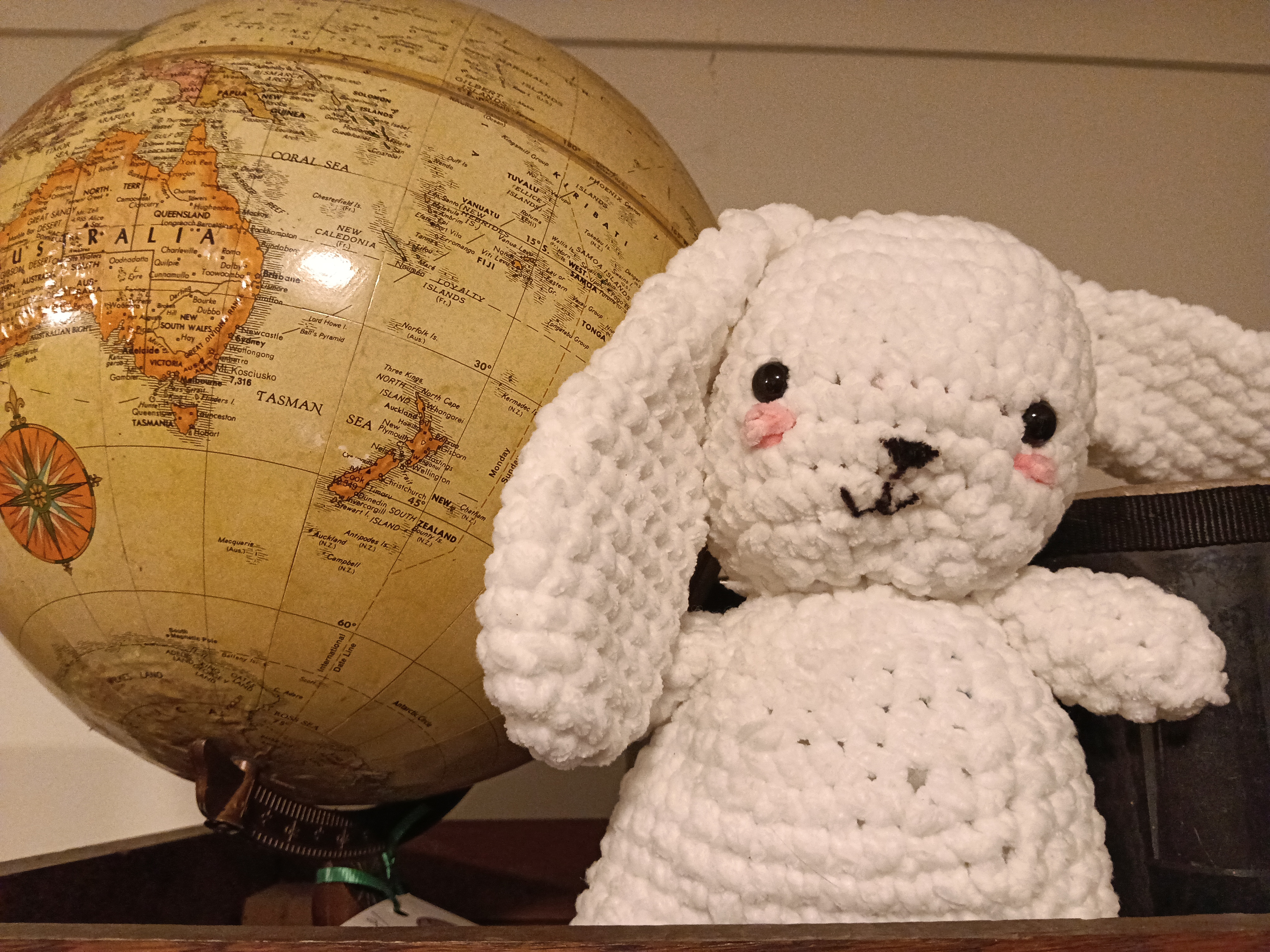
Student Year-End Koha
A custom-crocheted octopus plushy presented to me by a student at the end of 2025 as a token of appreciation.
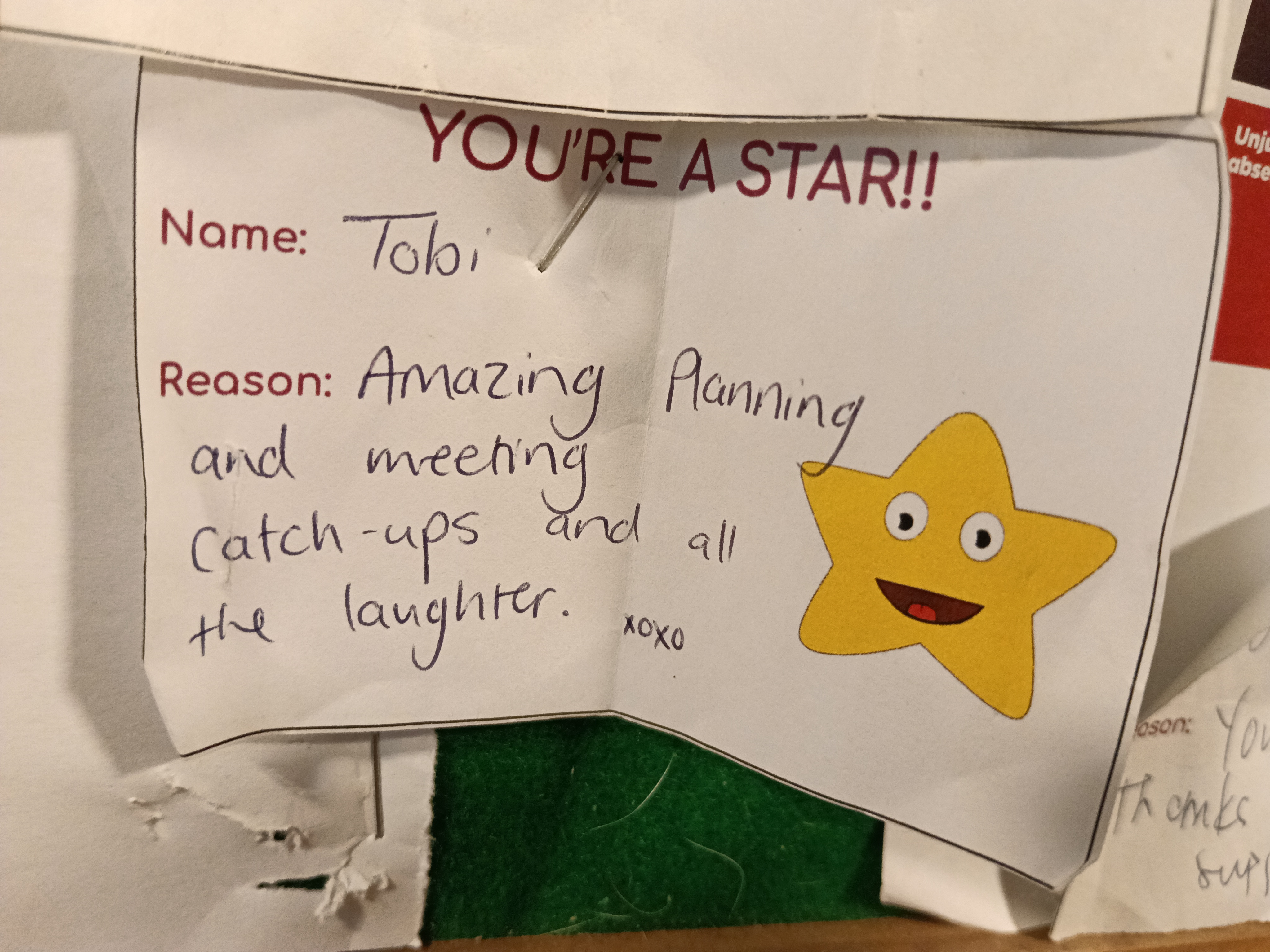
Learning Area Leader Commendation
Colleague commendation certificate for "Amazing planning and meeting catch-ups and all the laughter."