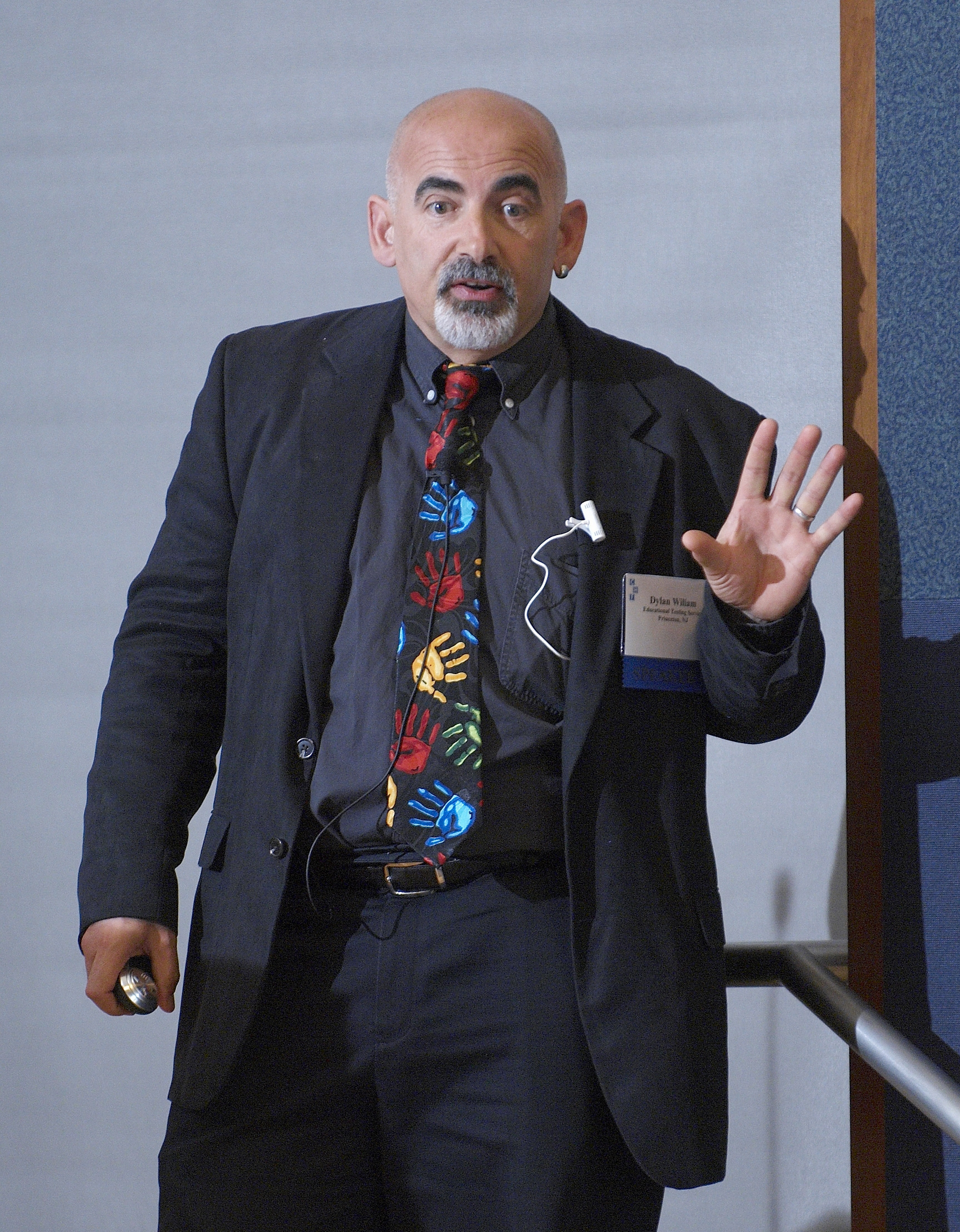
Dylan Wiliam
1954 – present · Assessment for Learning · Formative Assessment
The most important education researcher working in assessment. Wiliam’s synthesis with Paul Black — “Inside the Black Box” (1998) — proved that improving formative assessment had a larger positive effect on student achievement than any other educational intervention ever documented. His five key strategies remain the most practical evidence-based framework for everyday teaching.
“If I had to reduce all of the research on feedback into one simple overarching idea, at least for academic subjects, it would be this: feedback should cause thinking.” — Dylan Wiliam, Embedded Formative Assessment (2011)
🧑🎓 Biography & Context
Born in 1954 in Wales, Dylan Wiliam originally trained and worked as a secondary mathematics teacher in inner-London schools — an experience that grounded his research in classroom reality rather than laboratory conditions. He joined King’s College London, where his collaboration with Paul Black produced “Inside the Black Box” (1998), a literature review that synthesised the research on formative assessment and became one of the most cited papers in education research (8,000+ citations).
Wiliam later served as Deputy Director of the Institute of Education at University College London, and subsequently at ETS in Princeton. His 2011 book Embedded Formative Assessment became the most widely used professional development text in England and one of the most influential in Aotearoa. Unlike many educational researchers, Wiliam maintains close engagement with classroom practice, running professional development programmes with teachers directly.
A key distinction in Wiliam’s work: formative assessment is not a test. It is a process — any activity that generates information that teachers and students use to adjust teaching and learning. This reframing moved the profession beyond thinking of assessment as something that happens after learning, to something interwoven throughout every lesson.
📊 The Five Key Strategies of Formative Assessment
Wiliam and colleagues distilled their research into five interlocking strategies, grouped around three questions: Where are you going? Where are you now? How do you get there?
- Clarify, share, and understand learning intentions and criteria for success. Students cannot navigate toward a destination they cannot see. Success criteria should be co-constructed with students where possible.
- Engineer effective discussion, tasks, and activities that elicit evidence of learning. Questions and tasks designed to reveal thinking — not just confirm correct answers. Hinge questions are the premier tool here.
- Provide feedback that moves learning forward. Feedback should cause thinking, not just inform. Comment-only marking outperforms grade + comment (the grade hijacks attention).
- Activate students as learning resources for one another. Peer assessment, tuakana-teina, structured critique. Students learning from each other amplifies teacher impact.
- Activate students as owners of their own learning. Self-assessment, metacognitive monitoring, goal setting. The ultimate goal: students who can identify what they don’t know and know what to do about it.
🔧 Key Techniques in Practice
🌿 Aotearoa NZ Context
Assessment for Learning (AfL) is embedded throughout New Zealand curriculum frameworks. Te Mātaiaho (the refreshed NZC) explicitly frames assessment as ongoing, evidence-gathering, and student-centred — language drawn directly from Wiliam’s tradition. Ka Hikitia references formative assessment as critical for Māori student achievement.
The equity dimensions of Wiliam’s work are particularly significant in Aotearoa. Research consistently shows Māori and Pasifika students are underrepresented in voluntary-participation classroom discourse — they do not raise their hands as often, and teachers unconsciously call on them less. Wiliam’s “no-hands-up” and equity stick strategies directly disrupt this pattern, ensuring every student’s thinking is made visible and valued.
Wiliam’s framework is heavily individual-performance-focused. Collective and communal forms of assessment — common in Te Ao Māori and Pacific settings, including wānanga and tuakana-teina feedback — are underrepresented. His “feedback causes thinking” principle assumes a cognitive psychology that privileges individual rational agency over socially distributed knowing. Formative assessment in Māori-medium contexts predates Wiliam and has its own sophisticated traditions that his literature review did not capture.
🏫 Classroom Implications for Aotearoa Teachers
- Adopt no-hands-up as a default — use popsicle sticks, a random name generator, or “cold calling with warming” to ensure all students participate. This is an equity practice, not just a discipline strategy.
- Design at least one hinge question per lesson — identify the key conceptual moment where understanding forks. Design a question that reveals which path each student is on.
- Separate grades from developmental feedback — on formative work, give only comments. Reserve grades for summative pieces and ensure summative grades don’t dominate the feedback conversation.
- Use exit tickets as planning data, not marking — sort responses into three piles (got it / nearly / not yet). Let the not-yet pile determine tomorrow’s lesson opening.
- Teach students to use success criteria for peer feedback — students who can apply criteria to others’ work understand those criteria at a deeper level than those who just receive feedback.
- Build self-assessment routines — weekly “I used to think... now I think...” reflections or learning journals build the metacognitive capacity that Wiliam identifies as the ultimate goal.
📚 Academic References
-
Black, P., & Wiliam, D. (1998). Inside the Black Box: Raising standards through classroom assessment.
Phi Delta Kappan, 80(2), 139–148.
🎓 Google Scholar ↗ -
Wiliam, D. (2011). Embedded Formative Assessment. Solution Tree Press.
🎓 Google Scholar ↗ -
Wiliam, D., & Leahy, S. (2015). Embedding Formative Assessment: Practical techniques for K–12
classrooms. Learning Sciences International.
🎓 Google Scholar ↗ -
Black, P., Harrison, C., Lee, C., Marshall, B., & Wiliam, D. (2003). Assessment for Learning: Putting
it into practice. Open University Press.
🎓 Google Scholar ↗ -
Ministry of Education New Zealand. (2009). Assessment for Learning: Using evidence to support student
learning. Learning Media.
🎓 Google Scholar ↗
Mātauranga Māori Lens
Wiliam's formative assessment techniques — structured classroom discussion, peer feedback, and responsive questioning — align with the Māori pedagogical principle of whanaungatanga: learning deepens through sustained, respectful relationship. His "no hands up" strategy and random questioning patterns reflect the tuakana-teina principle, where every learner is both capable of contributing and responsible for the learning of others.
Wiliam's finding that quality feedback must address "where are you going, how are you going, and where to next" mirrors the whakamāramatanga process in traditional Māori knowledge transmission — making understanding visible in order to build the next layer. Crucially, his research shows that feedback only works when the learner has the safety and mana to act on it. In a Māori context, this is manaakitanga in practice: the teacher's role is to create the conditions in which the learner's mana is never threatened by the process of being assessed.
🌿 Use this in classroom
Use hinge questions at the midpoint of lessons — but frame them in ways that connect to students' cultural contexts. For Māori learners, a hinge question that draws on a te ao Māori scenario (kaitiakitanga, community responsibility, tino rangatiratanga) both assesses understanding and signals that their world matters in your classroom. Whanaungatanga and formative assessment are natural allies.