🦒 Hamilton Zoo Map Adventure 🐘 Pakihi Kōpere Kirikiriroa
🎯 Your Mission | Tō Kaupapa
Welcome to Hamilton Zoo, explorer! 🎉
You just arrived at the START point in the car park. Now you need to find different animals using our special map!
🗺️ How to Use This Map
- Grid Squares: The map is divided into squares like a chess board
- Finding Places: Use the numbers along the edges to find locations
- Moving Around: Count squares to see how far things are apart
- Starting Point: Look for the red pulsing dot - that's where you begin!
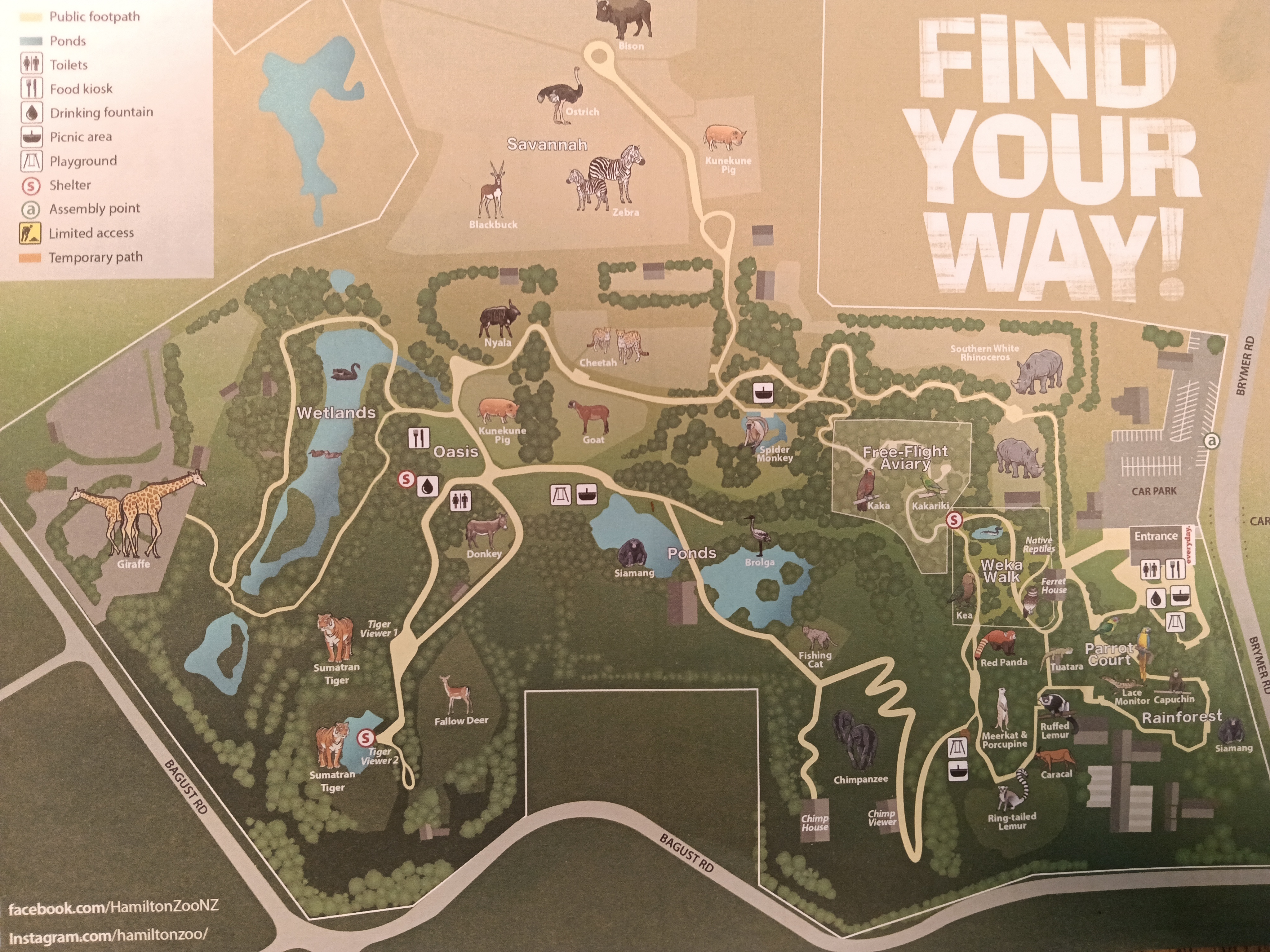
🔍 Activity 1: Finding Animals
Look at the map and find these animals! Write the letter and number for each one.
🦒 Giraffes: Letter Number
🐘 Elephants: Letter Number
🐅 Tigers: Letter Number
👣 Activity 2: Counting Steps
🧮 Counting Helper
How to count squares:
- Put your finger on the START point
- Count how many squares you move across (left or right)
- Count how many squares you move up or down
- Add them together!
From your START point, count how many squares to reach each animal:
| Animal | Squares Across | Squares Up/Down | Total Squares |
|---|---|---|---|
| 🦒 Giraffes | |||
| 🐘 Elephants | |||
| 🐅 Tigers |
🎯 Activity 3: Which Animal First?
You want to visit all three animals, but which one should you visit first?
Look at your counting from Activity 2. Which animal needs the smallest number of squares to reach?
I should visit the first because it only takes squares to get there!
🔍 Activity 4: Treasure Hunt!
There are other cool things at the zoo too! Can you find them?
🎠 Playground: Letter Number
🍕 Food Area: Letter Number
💧 Water/Lake: Letter Number
🤔 Activity 5: Planning Your Day
You're getting hungry! Plan the best route to get food.
You're still at the START point. You want to see one animal, then get food.
My plan:
1. First, I'll visit the
2. Then I'll go to the food area
3. This is a good plan because:
🌟 Activity 6: Help a Friend!
Your friend is lost! They tell you they can see elephants and a playground.
Look at your map. Where do you think your friend is?
My friend is probably at: Letter Number
How do you know?
🎉 Well Done! | Ka Pai!
You've completed the Hamilton Zoo Map Adventure!
You now know how to:
- ✅ Find locations using letters and numbers
- ✅ Count squares to measure distances
- ✅ Plan efficient routes
- ✅ Help others using map references
🎯 Teacher Notes | Ngā Kōrero Kaiako
Year 6 Learning Objectives:
- Simple Grid References: Using letters and numbers to locate positions
- Basic Counting: Counting grid squares for distance
- Spatial Awareness: Understanding relative positions
- Problem Solving: Planning simple routes
- Communication: Describing locations clearly
Simplifications for Year 6:
- Bigger Grid: Only 5×4 squares instead of complex coordinates
- Letters + Numbers: A1, B2 format instead of (x,y) coordinates
- Visual Cues: Animal emojis, bright colors, clear labels
- Simple Counting: Just add squares across + squares up
- Real Context: Focus on practical zoo navigation
Extension Ideas:
- Draw their own zoo map with a grid system
- Create treasure hunt clues using grid references
- Use classroom or playground as practice grid
- Compare this map to other maps they know (school, neighborhood)
Ngā Whāinga Akoranga — Learning Intentions
- Students can use alphanumeric grid references (A1, B2) to identify locations on a zoo map.
- Students can count grid squares to estimate the distance between two locations.
- Students can plan a simple route between two points on the grid, describing it clearly to a partner.
- Students can compare their route with a classmate's and explain why different routes may be equally valid.
Paearu Angitu — Success Criteria
- I can give the grid reference for at least 3 animal enclosures on the zoo map.
- I can count the squares between two locations and say how many squares apart they are.
- I can describe a route using directions (left, right, up, down / rāwhiti, hauāuru).
- I can explain my route to a classmate clearly enough for them to follow it.
Teacher Planning Snapshot
Curriculum Alignment
Te Mataiaho Mathematics and Statistics — Phase 2 (Year 6). Geometry strand: alphanumeric grid references, plotting positions on a grid map. The zoo context applies spatial reasoning to a real-world navigation task. Related: English communication (describing routes clearly to a partner).
Mātauranga Māori Lens — Te Ara Tūhura
Grid references are a system for giving every place a name so it can be found and shared. Māori have always named places — in Kirikiriroa (Hamilton), every hill, river bend, and valley has a name that carries the memory of events and relationships. At Hamilton Zoo (Kirikiriroa), students are navigating land that Waikato iwi know through its place-names. Using te reo Māori compass directions — rāwhiti (east), hauāuru (west), tonga (south), raro (north) — connects grid navigation to traditional wayfinding. Kaitiakitanga: the zoo's conservation work for endangered species grounds the mathematics in ecological responsibility.
Entry / On-level / Extension
- Entry: Provide a simplified 3×3 grid with large labels. Students find animals using teacher-guided prompts ("which animal is in A1?"). Use physical tokens on a printed map.
- On-level: Students use the full 5×4 grid independently. Plan a route that visits one animal then the café. Describe the route to a partner.
- Extension: Design their own zoo map with a grid system and write clues for a treasure hunt. Compare the alphanumeric system with an (x, y) coordinate system — what is the same? What is different?
Inclusion and Accessibility
- Visual: Animal emoji icons and bright colour-coded enclosures on the grid — students can identify locations visually before using grid references.
- Neurodiversity: One task at a time. Print a large-format version of the grid for students who need tactile engagement. Physical tokens (counters) to track movement across the map.
- EAL/D: Bilingual direction labels available (English / te reo Māori). Route descriptions accepted verbally, as drawings, or in any language.
- Early finishers: Extension ideas built into the teacher notes. Students who finish can create their own grid challenges for classmates.
Curriculum alignment
- Geometry — Knowledge: - An alphanumeric grid reference is a system that divides a map into labelled rows (letters) and columns (numbers), so that each square can be identified by combining a letter…
- Geometry — Practices: - Use alphanumeric and general grid references to identify regions and plot positions on a grid map
- Text Studies — Knowledge: Communication for Learning — Knowledge (Phase 1): - Words can be used to ask for help, share needs, and express preferences (e.g., 'can you help me please?', 'I like this …').…
- Language Studies — Knowledge: Communication for Learning — Knowledge (Phase 1): - Words can be used to ask for help, share needs, and express preferences (e.g., 'can you help me please?', 'I like this …').…
- Text Studies — Knowledge: Discussions have different purposes (e.g. sharing ideas, asking questions, giving feedback, and solving problems) and ways of participating (e.g. offering suggestions or opini…